



How to Be More Effective Building and Managing Your Sales Pipeline
Sales is entrepreneurship, and your pipeline is your business — you should be reviewing and analyzing this on a regular basis to grow your business.

Sales is entrepreneurship, and your pipeline is your business — you should be reviewing and analyzing this on a regular basis to grow your business.
IMAGE: Getty
THE SALES EQUATION
There is a level of skill and personality that contributes to sales success, but the main ingredient to success is in the numbers. Many of the best salespeople you will meet found their success because they understood the equation, which in its most basic form is: You need to put enough into the funnel to get something back out. This isn’t water we’re talking about going into the funnel, where it all eventually drips out. On average you will find that salespeople close between 20-30% of the opportunities they uncover and prospect.
So, how do you know how much to put into your sales funnel? You need to work the math backwards, and I encourage you to be conservative. For example, Jill is a salesperson that needs to close one deal each month. If Jill has a 25% closing ratio, she needs to do a minimum of four presentations each month to hit her one closed deal. To get four presentations scheduled, Jill needs to have initial meetings with 16 prospects.
It’s typically much easier to schedule an initial, fact-finding meeting, or even to have one on the spot if you are prospecting in person, than it is to secure a presentation or signed agreement. Therefore, the 4-to-1 ratio may not apply to how many prospects you need to dump into your sales funnel each month. Let’s say 50% of the time you attempt to engage with a new prospect, you are successful in scheduling an initial meeting or gathering information that you can leverage to illustrate why they should meet with you. In that example, you would need to add 32 new prospects into your sales funnel each month. You will eventually get better at pinpointing these specific numbers based on your own individual sales skill and success. However, if you plan conservatively, you will be better off. The worst thing that would happen is closing more business than you anticipated. That’s a great problem to have.
IDENTIFYING GOALS
It is important for salespeople to have a solid understanding of what is expected of them. Each sales role is different and maintains different objectives and goals. It could be understanding a monthly quota of revenue or quantity of accounts generated, or this may be in quantity of presentations scheduled for executive management. Other scenarios include understanding the revenue generated by a team if you are in management, and so on. Regardless, if you are unclear of what goals you are shooting for, you must meet with your supervisor and get on the same page about what they should be. You can’t use the sales equation described above and work backwards from a goal if you don’t know what that goal is.
This can sometimes feel like a difficult conversation to have, especially if you are early in your career or new to sales. I promise you, the conversation you will have when you are not meeting the expectations you were unclear about or unaware of will be much more difficult. An effective phrasing you can use to request this meeting is: “I want to be sure I am managing my time appropriately and meeting your expectations. Can you please let me know your earliest availability so we can discuss my goals and/or quota to ensure we are aligned?” It is a conversation based on numbers. Once you understand the goals, you can use the sales equation and confirm with your manager that you are targeting the appropriate number of prospects compared to what other successful salespeople on your team are adding to their pipelines.
STAYING ON TRACK
Once you have identified your goal and used the sales equation to determine the numbers, break it out into each sales stage to visualize your pipeline:
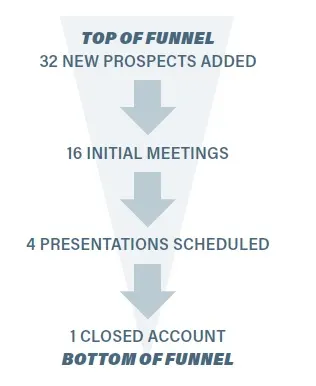
It is important to review and analyze your pipeline frequently to make sure you have the appropriate number of opportunities in each deal stage to maintain consistency with closing business. If you go a couple of months without closing business, maybe you find you have not been adding enough opportunities to secure the necessary number of presentations. It could also mean your closing percentage may be slightly lower than the average salesperson, and you need more opportunities going into your pipeline to close the expected number of accounts. You also need to consistently replenish your pipeline to get your next closed account.
In working with and training salespeople, I encourage them to analyze their pipeline backwards. The questions they need to ask include: Have I scheduled or completed enough presentations to actually close an account? Have I conducted enough initial meetings to ensure a percentage of them will convert into a full presentation or proposal? Am I finding (through research or leads) and reaching out to enough new prospects to continue having the number of initial meetings I need? If you notice a cork in the funnel where you are not moving opportunities onto the next stage, at the rate you expect, and are unsure why, you should reach out to your manager for strategic assistance.
KEY TAKEWAYS:
Be aligned with your manager about your sales goals or quota.
Work backwards using the sales equation to determine how many prospects you need to be adding to your funnel.
Never take your foot off the gas! Make sure to keep replenishing your funnel as you close business and/or determine what your closing percentage is over time.
Sales is entrepreneurship and your pipeline is your business — you should be reviewing and analyzing this on a regular basis to grow your business.
Danielle Cumbee is director of sales integration at Spectrum Automotive Holdings.
Originally posted on F&I and Showroom
More Dealer Ops

How to Avoid Phone Scams | Dealer Debrief 09/10/2026
Are you taking the necessary steps to protect your dealership and customer data from phone-based scams? This week's Dealer Debrief breaks down how!
Read More →
Dealer Debrief: August Auto Sales
Gas-powered engines still dominate the U.S. vehicle market, but hybrids are gaining ground as consumers look for ways to cut their gas costs.
Read More →
Dealership Profits Decline
While new and used retail sales stagnated, dealerships have been particularly supported by fixed operations and finance-and-insurance profits, according to a new report.
Read More →
Dealer Debrief: Defection Data & EV Updates
In this week's debrief, host Lauren Lawrence discusses how to use defection data to your advantage and the latest on EV sales and charging infrastructure.
Read More →
How Defection Data is Bridging the Dealership Conversion Gap
Lead volume is flat, cross-shopping is up and brand loyalty is in retreat. As confident sales teams keep losing buyers they thought they had, daily industry sales data is showing dealers exactly where their funnel is breaking and how to fix it without buying a single new lead.
Read More →
Dealer Debrief: Where are you losing customers?
In this week's debrief, host Lauren Lawrence discusses the hidden leaks in dealerships where you might be losing customers without even realizing it.
Read More →
Dealer Debrief: Improving Your Inventory Management
In this week's debrief, host Lauren Lawrence covers a new survey that shows what service technicians really want and two launches that could help improve your inventory and vehicle life cycle management.
Read More →
Ladies and Gentlemen, This Is a Dealership: Why the Fundamentals Still Decide Who Wins
A teaching moment by a legendary football coach happens to apply perfectly in the auto retail space. Learn what it is and how to use it to your store’s advantage.
Read More →
Dealer Ads and the FTC
The agency has made it clear in recent enforcement actions and warnings, in auto retail and other industries, that advertised prices must include all nonoptional costs to the consumer.
Read More →
Used Autos Supply Dwindles
The March shopping surge, despite high prices, cut into inventory by the most since the thick of the pandemic, Cox Automotive analysts calculated.
Read More →