



Lessons From the Soviet Streets
Agents would do well to adapt a former teen black-market entrepreneur’s tactics to get into dealer principals’ offices.

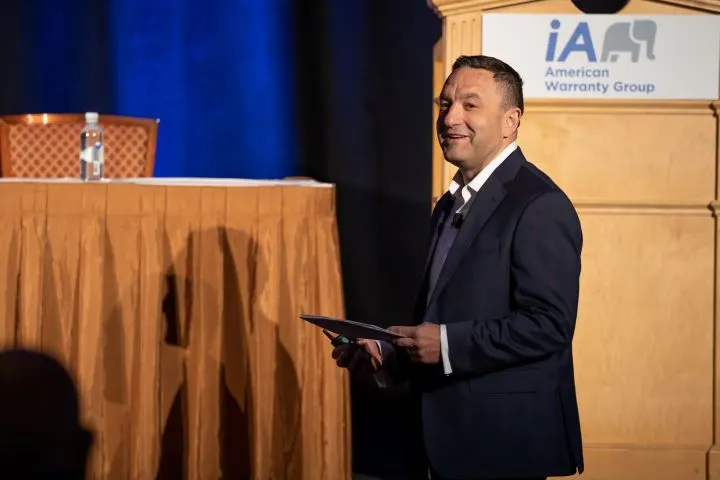
Troussov developed the foundation of his sales strategy as a teenager on the mean Soviet streets.
When Tony Troussov was 15 in the former Soviet Union in the late 1980s and early 1990s, he wasn’t spending a lot of his time listening to Western pop music or hanging out with his friends. He was selling products to tourists on the black market.
Looking back on his business exploits, now that he owns one of the fastest-growing agencies in the U.S., he sees that the lessons he learned from that often-dangerous experience apply to an auto dealer agent’s work, including sometimes keeping things close to the vest.
“The Soviet system didn’t allow for entrepreneurship,” the Mezen Dealer Services owner told agents attending Bobit Dealer Group’s recent Agent Summit. “They were ready to put me in jail for two to five years.”
Not only that, but the newly formed Russian mafia was targeting entrepreneurs like himself.
“I had to jip and jive and figure my way around to survive,” he said as he paced the floor in front of the speaker’s podium, his audience listening intently to his story.
By the time he’d saved enough rubles for his wedding and immigrated to the States with his new bride when he was 18, Troussov had learned valuable sales methods that he was able to translate to the car business, though he was just learning English.
A Scrappy Teen’s Approach
“I learned how to spot a trade candidate,” he said, explaining that he was referring to tourists, his first customers.
“I learned how talk to strangers – I could walk up to any age group,” he continued. “I learned how to develop a process. It was actually a very profitable process – it was a one-dollar-for-20-rubles exchange rate,” he said with a chuckle.
“I learned how to be street smart. I learned to figure out how to do things on fly, and I learned to see deals everywhere.”
He and his wife, Maria, had arrived with “two half-full suitcases and $50” and no relatives in the States. But he managed to join the automotive industry as a car salesman and work his way up, eventually becoming general manager of a top-100 Toyota dealership, then corporate finance-and-insurance director for a large dealer group in the Minneapolis metro area.
Applying Lessons Learned
Then he joined an agency and saw he needed to employ those skills he’d learned on the Soviet streets. On a 10-stop day of calls with an experienced colleague on Troussov’s first day on the job, he made a mental note to develop a process.
“I learned, if I were to sell just one product, it would take forever to make a paycheck,” he told the audience of agents. “I can’t have a portion of the dealer’s wallet – I have to have all of it.”
Another early learning tied back to his Soviet street-smarts lesson: “No one will carry your water for you,” meaning don’t rely on anybody to get you a meeting with a dealership’s ultimate decision-maker. That must be on you to see it through, because, though someone else in a dealership may have the best intentions, it’s rare that anyone will introduce you to the dealer principal. If they do offer to introduce you, ask them when you can both talk with the principal together.
“I learned, with relentless follow-up, you can get in front of the dealer,” he said. “Nobody will pitch your deal better than you.”
But a dealer, as agents know well, will give an array of excuses to avoid a meeting with them. Troussov ticked off some: “I’m busy with …,” “I’ll be out of town;” “Now is not a good time;” “Check back in.”
If you can, it’s ideal to get the principal’s cellphone number. That way, “You’re pretty much halfway to getting into their door,” Troussov said.
And once you do get a face-to-face with a dealer, they typically respond with at least one familiar objection: “I’m happy with my current provider,” Troussov quoted from memory. “I don’t know you;” “There’s nothing you can do that my current provider can’t.”
“They’re really thinking that,” Troussov said of the last objection.
In fact, just 4% of dealers at a given time are looking to switch providers, he said. “Recognize it’s going to take some time … but if you do everything right, everything will fall into place.”
Five Steps to the All-Important Office
The most important piece for an agent is to bring value to dealers through the training and development you’ve done, and to take a colleague with you on your calls to dealerships, he said.
Beyond that, Troussov advises following five steps he employed as an agent to get your foot in a principal’s door:
1. Know who the decision-maker is.
“Sometimes you think it’s a dealer principal, but it’s not,” he said. “The father oversees F&I, and the daughter is the dealer principal.” When starting out, start targeting small wins to boost your confidence and help you develop a process, instead of going after a big dealer group.
“If you’re in a metro area, start outside the metro. Find a dealer who you can find their picture on the website. It’s good for your business – diversification. Sometimes they’re very appreciative of what you do for them.”
2. Know how to talk your way in. With a smile, chat with whichever gatekeepers you encounter, gathering any information you can about the store and the principal, and ask for the principal by name to demonstrate familiarity. If the principal is in a meeting, ask for a good day to return so that you can develop an action plan in the meantime.
Sometimes a principal will appear to meet with you, so always be prepared in case that happens, Troussov said.
“You’re not trying to sell the agency at the time. Say, ‘I was just introducing myself. When would be a good time to schedule in a week or two to go over what we offer?’”
3. Develop a process. Plan your dealership visit, visualizing how you’ll talk with the principal. Plan what you and your colleague will say. Define your objective, meaning what and how you’re selling. Make sure you know the dates you’re available for a meeting if you don’t get one that day. And be ready to deal with objections.
“Sometimes the best way to talk about objections is before they come up,” Troussov said.
4. Be flexible. This is where Troussov’s street smarts come in. An agent never knows what might transpire in or before a principal meeting. If it’s a warm introduction, you have time to prepare, but, “When you walk into the unfamiliar situation, you have to be flexible and have to adapt. That’s going to separate you from the competition.”
5. See deals everywhere, like the teenage Troussouv did in Russia. He said that perspective helped him build an agency here, then establish his own. It helps you be creative, he explained, developing ideas that grab a dealer’s attention.
“If you’re not an optimist by nature, start seeing deals everywhere,” he said.
After the first meeting with a principal, an agent will know the best approach, whether it’s bringing in a resource, such as a wealth manager, or something else, he said. “Use whatever tools you have as an agent.”
His own innovativeness as a young entrepreneur back in his native country shows that street-smart thinking can serve an agent well. How did he thwart the forces threatening to derail his business then, for instance?
“I had hidden pockets in my jacket,” he recalled of his method to keep his merchandise sales from the Russian police. “When I opened it up, they didn’t notice them.”
When he saw the mafia headed his way, on the other hand, he ran.
Hannah Mitchell is executive editor of Agent Entrepreneur. A former daily newspaper journalist, her first car was a hand-me-down Chevrolet Nova.
Originally posted on Agent Entrepreneur
More Dealer Ops
How to Avoid Phone Scams | Dealer Debrief 09/10/2026
Are you taking the necessary steps to protect your dealership and customer data from phone-based scams? This week's Dealer Debrief breaks down how!
Read More →
Dealer Debrief: August Auto Sales
Gas-powered engines still dominate the U.S. vehicle market, but hybrids are gaining ground as consumers look for ways to cut their gas costs.
Read More →
Dealership Profits Decline
While new and used retail sales stagnated, dealerships have been particularly supported by fixed operations and finance-and-insurance profits, according to a new report.
Read More →
Dealer Debrief: Defection Data & EV Updates
In this week's debrief, host Lauren Lawrence discusses how to use defection data to your advantage and the latest on EV sales and charging infrastructure.
Read More →
How Defection Data is Bridging the Dealership Conversion Gap
Lead volume is flat, cross-shopping is up and brand loyalty is in retreat. As confident sales teams keep losing buyers they thought they had, daily industry sales data is showing dealers exactly where their funnel is breaking and how to fix it without buying a single new lead.
Read More →
Dealer Debrief: Where are you losing customers?
In this week's debrief, host Lauren Lawrence discusses the hidden leaks in dealerships where you might be losing customers without even realizing it.
Read More →
Dealer Debrief: Improving Your Inventory Management
In this week's debrief, host Lauren Lawrence covers a new survey that shows what service technicians really want and two launches that could help improve your inventory and vehicle life cycle management.
Read More →
Ladies and Gentlemen, This Is a Dealership: Why the Fundamentals Still Decide Who Wins
A teaching moment by a legendary football coach happens to apply perfectly in the auto retail space. Learn what it is and how to use it to your store’s advantage.
Read More →
Dealer Ads and the FTC
The agency has made it clear in recent enforcement actions and warnings, in auto retail and other industries, that advertised prices must include all nonoptional costs to the consumer.
Read More →
Used Autos Supply Dwindles
The March shopping surge, despite high prices, cut into inventory by the most since the thick of the pandemic, Cox Automotive analysts calculated.
Read More →