



No Haggle? No Problem. Or Not.
The magazine’s legal wiz believes that dealers who advertise no-haggle pricing should be safe from legal action — unless, of course, they haggle.
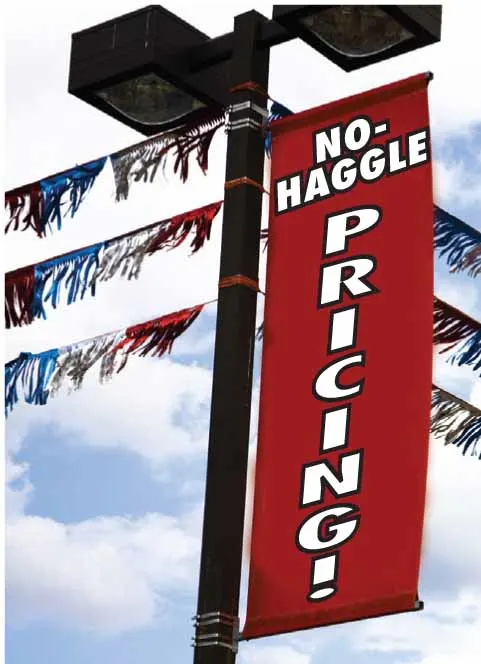
Fads, by definition, come and go. Sales methods can be faddish. One method that has been around a couple of times — and seems to be coming around again — is “no-haggle” pricing. The editors at Auto Dealer Monthly called to say they were planning a story that would focus on this topic, then asked whether a dealer could get into trouble for using no-haggle pricing.
Hmmm.
Let’s assume that the dealer’s no-haggle policy is splashed all over billboards, the Internet, print advertising, radio and TV, and that the advertising doesn’t say anything about pricing other than the bald no-haggle statement.
Then let’s assume that the dealer haggles.
My first thought was to wonder what the Federal Trade Commission might think about this scenario. I’m fortunate in that the fellow who, for ages, headed up the FTC unit responsible for advertising violations, Joel Winston, is now my partner. I put the question to him.
Joel’s reply? “I suppose it could be considered deceptive,” he says, “but it depends on how reasonable consumers interpret ‘no-haggle pricing.’ It could mean we never negotiate with anyone, but there are other interpretations possible. In any event, the consumer injury would appear to be very low and it’s not a very appealing case for the government.”
Okay, so the feds wouldn’t get their knickers in a twist over the practice, but what about the possibility of a suit by one of the dealer’s customers?
I promptly took off my dealer lawyer’s white hat and reached for my customer lawyer’s black hat. Pretending that I was looking for any way possible to sue a dealer with whom my client had a beef, I started thinking about possible ways I could attack a dealer’s no-haggle pricing strategy.
Here’s how I would analyze the facts: My client went to the dealership to buy a car. Based on the dealer’s stated “no-haggle” policy, my client cheerfully paid $29,995 for his new Belchfire V-6, thinking that he had no choice but to do so. After all, that’s what “no-haggle” means, right? Two days later, my client’s brother-in-law goes to the same dealership, picks out the same car and says, “I’ll take it, but my top offer is $29,500.” The dealer takes the offer. He haggled.
“So what?” you ask.
So this: most states have a law with a title such as “unfair and deceptive sales practices” or “unfair and deceptive acts and practices.” The laws are usually general, with the terms “unfair” and “deceptive” not defined, or very broadly defined. These laws are favorites of plaintiffs’ lawyers because, with broadly defined terms, it’s hard to get a case dismissed in its early stages, favoring consumers over dealers. The laws also frequently provide that a successful plaintiff can recover some multiple, often double or triple, of their actual damages and attorneys fees.
So, staying in character, I take off my black hat for a moment and scratch my head. “Hmmm,” I say. “This dealer said he doesn’t haggle, but he does, and I can prove it. Maybe I’ll bring a class action lawsuit against the dealer on behalf of all of those buyers who relied on the dealer’s no-haggle claim and bought without attempting to haggle.”
So I file the lawsuit on my client’s behalf, and then get into what the lawyers call “discovery.” Modern court rules, in an effort to minimize surprises at trial, permit the parties to “discover” the facts of the other party’s case by demanding documents, taking depositions, asking for admissions of facts and the like. As part of my discovery, I’ll be looking at the dealer’s pricing practices for the car, finance rates, service contracts, GAP and all the other F&I products, looking for instances in which the dealer and the customer engaged in haggling.
You get the idea. My answer to the ADM editors is that a determined plaintiffs’ lawyer can come up with ways to attack a “no-haggle” policy if, in fact, the dealer haggles.
Would such a lawsuit be successful? That would depend on lots of facts that we haven’t considered yet. What if the dealer’s advertisements said,
“We cater to buyers who don’t want to haggle”? That’s a different claim from “no-haggle” it and makes the buyer’s case harder. Or the dealer might argue that saying “no-haggle,” was just a harmless form of “puffery,” that buyers didn’t take literally.
So go no-haggle if you want, but unless you intend never to haggle, talk the program over with your lawyer before you do.
Thomas B. Hudson is a partner in the firm of Hudson Cook LLP and the author of several widely read compliance manuals. CounselorLibrary.com 2014, all rights reserved. Based on an article from Spot Delivery. Single print publication rights only, to Auto Dealer Monthly (4/14). HC# 4818-3850-5497. THudson@AutoDealerMonthly.com
More Dealer Ops
How to Avoid Phone Scams | Dealer Debrief 09/10/2026
Are you taking the necessary steps to protect your dealership and customer data from phone-based scams? This week's Dealer Debrief breaks down how!
Read More →
Dealer Debrief: August Auto Sales
Gas-powered engines still dominate the U.S. vehicle market, but hybrids are gaining ground as consumers look for ways to cut their gas costs.
Read More →
Dealership Profits Decline
While new and used retail sales stagnated, dealerships have been particularly supported by fixed operations and finance-and-insurance profits, according to a new report.
Read More →
Dealer Debrief: Defection Data & EV Updates
In this week's debrief, host Lauren Lawrence discusses how to use defection data to your advantage and the latest on EV sales and charging infrastructure.
Read More →
How Defection Data is Bridging the Dealership Conversion Gap
Lead volume is flat, cross-shopping is up and brand loyalty is in retreat. As confident sales teams keep losing buyers they thought they had, daily industry sales data is showing dealers exactly where their funnel is breaking and how to fix it without buying a single new lead.
Read More →
Dealer Debrief: Where are you losing customers?
In this week's debrief, host Lauren Lawrence discusses the hidden leaks in dealerships where you might be losing customers without even realizing it.
Read More →
Dealer Debrief: Improving Your Inventory Management
In this week's debrief, host Lauren Lawrence covers a new survey that shows what service technicians really want and two launches that could help improve your inventory and vehicle life cycle management.
Read More →
Ladies and Gentlemen, This Is a Dealership: Why the Fundamentals Still Decide Who Wins
A teaching moment by a legendary football coach happens to apply perfectly in the auto retail space. Learn what it is and how to use it to your store’s advantage.
Read More →
Dealer Ads and the FTC
The agency has made it clear in recent enforcement actions and warnings, in auto retail and other industries, that advertised prices must include all nonoptional costs to the consumer.
Read More →
Used Autos Supply Dwindles
The March shopping surge, despite high prices, cut into inventory by the most since the thick of the pandemic, Cox Automotive analysts calculated.
Read More →