



November Sales Report Pushes 2019 Total Closer to 17M
All but a few Asian and highline factories reported double-digit gains in U.S. sales last month, priming the industry for a big December and a fifth straight 17 million-unit year.

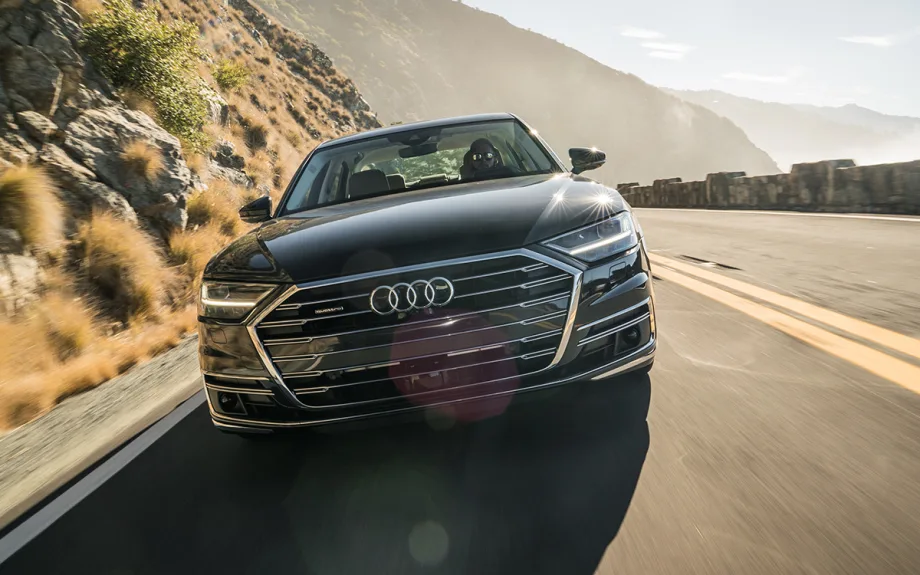
Sales of the Audi A8 improved by 50% year-over-year last month, helping to propel the German factory to 20,618 U.S. new-car deliveries, a new November high.
Photo courtesy Audi USA
(Bobit) — The estimated seasonally adjusted annualized rate of U.S. new vehicle sales continues to hover around the 17 million-unit mark after several major manufacturers — and nearly every highline factory — enjoyed year-over-year improvements in November.
Reports and estimates compiled by Automotive News put the SAAR in the 16.9 to 17.5 million range, an improvement on the 16.55 million-unit mark set in October. Precise month-to-month calculations are no longer possible since General Motors, Ford, and Fiat Chrysler switched to quarterly sales reports this year.
Read: October Sales: SAAR Could Hit 17M for 5th Straight Year
Among mass-market manufacturers, Honda led the way with a 12.2% year-over-year gain, propelled by increases of 11.1% for the Honda brand 3.1% for Acura, all driven by an 18% increase in light truck sales.
Toyota reported a 9.2% improvement over November 2018, including a 13.8% increase in sales of the Lexus brand. Mazda (18%), Kia (12%), Volkswagen (9.1%), Mitsubishi (6.5%), Hyundai (6.2%), and Subaru (0.2%) also reported year-over-year gains.
“While the Detroit automakers may believe cars are bad business, the Japanese and Korean automakers view the market differently,” said Brian Moody, executive editor at Autotrader. “They are investing in good sedans; consumers, turned away by the Detroit Three, are finding what they want from the Asian brands. Nissan and Toyota actually delivered increases in year-over-year car sales. … Don’t believe the mainstream media talking point — cars are not dead in America.”
“Whether car or SUV, the availability of new and refreshed products is being rewarded by consumers.”
“These successes do not suggest a revival for sedans is in the offing, but we may see a new normal pace for the segment evolving,” countered Stephanie Brinley, principal automotive analyst for IHS Markit. “Whether car or SUV, the availability of new and refreshed products is being rewarded by consumers.”
Among luxury carmakers, Genesis continued to set the pace with a 400%-plus year-over-year improvement, trailed by Audi (20.7%), Volvo (17.8%), Mercedes-Benz (13.3%), Porsche (11.5%), Land Rover (11.3%), and BMW (10.2%).
Not faring as well were Nissan (-15.9%), Mini (-13.1%), and Jaguar (-7.5%). Cox Automotive analysts estimated that each of the Detroit factories suffered modest declines, predicting a 5.5% loss for GM — which continues to recover from a six-week work stoppage that ended Oct. 25 — and year-over-year decreases of 3.5% and 2.7% for Fiat Chrysler and Ford.
“Still, the U.S. consumer, motivated in part by low unemployment rates, continues to drive the economy forward. Vehicle shoppers in November were met with good discounts on older inventory and responded accordingly,” said the firm’s senior economist, Charlie Chesbrough.
Read: Discounts, Incentives Stabilize New Vehicle Prices in November
Indeed, J.D. Power and LMC analysts said average new vehicle incentives exceeded the $4,500 mark for the first time, climbing 12% year-over-year to $4,538 per unit in November.
ALG analysts were more conservative, estimating an average of $3,759 in incentives applied to new vehicles sold in November, a 1.2% overall gain led by Honda (9.4%), Subaru (6.9%), and Kia (5.7%).
“Notably, incentive spending on a percentage basis is again growing at a faster rate than transaction prices.”
“While high inventories of older model-year vehicles is a considerable factor in the year-over-year growth, incentive spending on newer models is expected to eclipse last year. Spending on 2020 model-year vehicles is on pace to reach $3,723, an increase of nearly 13% from a year ago,” said Thomas King, senior vice president of J.D. Power’s data and analytics division.
“Notably, incentive spending on a percentage basis is again growing at a faster rate than transaction prices,” he added. “Manufacturer incentive spending as a percentage of MSRP in November is on pace to reach 11.1%, exceeding 11% for the first time in more than 10 years.”
More Dealer Ops

How to Avoid Phone Scams | Dealer Debrief 09/10/2026
Are you taking the necessary steps to protect your dealership and customer data from phone-based scams? This week's Dealer Debrief breaks down how!
Read More →
Dealer Debrief: August Auto Sales
Gas-powered engines still dominate the U.S. vehicle market, but hybrids are gaining ground as consumers look for ways to cut their gas costs.
Read More →
Dealership Profits Decline
While new and used retail sales stagnated, dealerships have been particularly supported by fixed operations and finance-and-insurance profits, according to a new report.
Read More →
Dealer Debrief: Defection Data & EV Updates
In this week's debrief, host Lauren Lawrence discusses how to use defection data to your advantage and the latest on EV sales and charging infrastructure.
Read More →
How Defection Data is Bridging the Dealership Conversion Gap
Lead volume is flat, cross-shopping is up and brand loyalty is in retreat. As confident sales teams keep losing buyers they thought they had, daily industry sales data is showing dealers exactly where their funnel is breaking and how to fix it without buying a single new lead.
Read More →
Dealer Debrief: Where are you losing customers?
In this week's debrief, host Lauren Lawrence discusses the hidden leaks in dealerships where you might be losing customers without even realizing it.
Read More →
Dealer Debrief: Improving Your Inventory Management
In this week's debrief, host Lauren Lawrence covers a new survey that shows what service technicians really want and two launches that could help improve your inventory and vehicle life cycle management.
Read More →
Ladies and Gentlemen, This Is a Dealership: Why the Fundamentals Still Decide Who Wins
A teaching moment by a legendary football coach happens to apply perfectly in the auto retail space. Learn what it is and how to use it to your store’s advantage.
Read More →
Dealer Ads and the FTC
The agency has made it clear in recent enforcement actions and warnings, in auto retail and other industries, that advertised prices must include all nonoptional costs to the consumer.
Read More →
Used Autos Supply Dwindles
The March shopping surge, despite high prices, cut into inventory by the most since the thick of the pandemic, Cox Automotive analysts calculated.
Read More →