



US ALG Residual Value Awards Announced
Accolades highlight excellence and attention to detail. Lexus, Honda again get top brand nods.

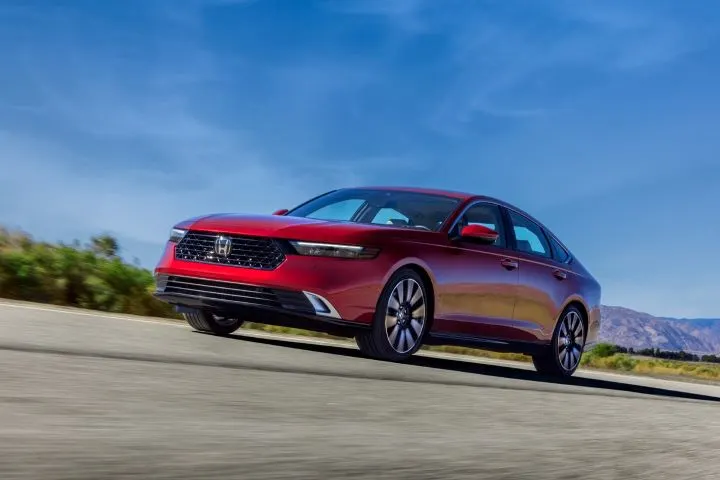
Honda won top honors in the mass-market category.
IMAGE: Honda
As new- and used-vehicle prices continue to rise, the resale, or residual, value has never been more important to consumers, according to the newly released J.D. Power 2024 U.S. ALG Residual Value Awards. For a fourth consecutive year, Lexus receives the brand award for best premium brand, while Honda receives the award for best mass-market brand for a third consecutive year. Three marques—Honda, Lexus and Toyota—were each recognized with four model segment winners.
“The continued strength of Lexus and Honda underscores an attention to detail and a unique strategy in terms of product planning and management,” said Kristen Lanzavecchia, director of customer success at ALG, the J.D. Power division focused on automotive residual value projections. “Overall, these brands took a measured approach in their freshening of products, trim levels and powertrains, resulting in higher residual performance and better long-term value for their customers.”
The more balanced Lexus and Honda trim-levels strategy is underpinned by entry-level vehicles that offered heightened product value. In terms of powertrains, Honda and Lexus were more conservative in their offerings of fully electric vehicles, providing a wider range of options, including traditional gas-powered, hybrid and plug-in hybrid variants.
For model year 2024, 15 brands receive awards in 28 segments, two more brand recipients than a year ago. The 2024 awards process evaluated 293 models through analysis of used-vehicle performance, brand outlook and product competitiveness. Eligibility for a brand awards requires a manufacturer to have model line entries in at least four vehicle segments. To account for differences across trim levels, model averages are sales weighted based on percentage share relative to the entire model line. For a segment to qualify for an award, at least four brands must be included. This year, the small-car segment car has only three model lines, so it doesn't qualify to have a segment recipient.
Model-Level Residual Value Awards
Honda,Lexusand Toyota each receive four model-level awards. Model award recipients include:
Honda: Civic, Accord, CR-V and Passport
Lexus: IS, NX, LX and RX
Toyota: GR Supra, Tundra, Tacoma and Sienna
Chevrolet: Corvette and Trax
Subaru: WRX and Crosstrek
Land Rover: Discovery and Range Rover Evoque
Jeep: Wagoneer and Wrangler
Acura: Integra
Ford: F-150 Lightning
GMC: Sierra 3500 HD
Jaguar: XF
Kia: Telluride
Mercedes-Benz: AMG GT 4-door Coupe
Ram: ProMaster
Tesla: Model Y
The U.S. ALG Residual Value Awards recognize vehicle models projected to hold the highest percentage of their manufacturer’s suggested retail price following a three-year period of ownership. The value retention is a key variable in the lease cost of a vehicle, underscoring an automaker’s success in the areas of long-term quality and design, as well as overall desirability of automotive brands and their models.
Numerous variables affect the actual residual value of a vehicle over a multiyear lease term. Examples include mileage, quality/reliability, options and feature sets, weather and macroeconomic environment. Since those factors must be taken into account in order to accurately forecast residual values, the more granularity and greater the understanding of the effect of each variable, the better equipped manufacturers and lenders are to be able to maximize profitability. The combination of J.D. Power insights and data with the deep experience of ALG in residual values allows for even more accurate end-of-lease forecasting capabilities.
More Dealer Ops

How to Avoid Phone Scams | Dealer Debrief 09/10/2026
Are you taking the necessary steps to protect your dealership and customer data from phone-based scams? This week's Dealer Debrief breaks down how!
Read More →
Dealer Debrief: August Auto Sales
Gas-powered engines still dominate the U.S. vehicle market, but hybrids are gaining ground as consumers look for ways to cut their gas costs.
Read More →
Dealership Profits Decline
While new and used retail sales stagnated, dealerships have been particularly supported by fixed operations and finance-and-insurance profits, according to a new report.
Read More →
Dealer Debrief: Defection Data & EV Updates
In this week's debrief, host Lauren Lawrence discusses how to use defection data to your advantage and the latest on EV sales and charging infrastructure.
Read More →
How Defection Data is Bridging the Dealership Conversion Gap
Lead volume is flat, cross-shopping is up and brand loyalty is in retreat. As confident sales teams keep losing buyers they thought they had, daily industry sales data is showing dealers exactly where their funnel is breaking and how to fix it without buying a single new lead.
Read More →
Dealer Debrief: Where are you losing customers?
In this week's debrief, host Lauren Lawrence discusses the hidden leaks in dealerships where you might be losing customers without even realizing it.
Read More →
Dealer Debrief: Improving Your Inventory Management
In this week's debrief, host Lauren Lawrence covers a new survey that shows what service technicians really want and two launches that could help improve your inventory and vehicle life cycle management.
Read More →
Ladies and Gentlemen, This Is a Dealership: Why the Fundamentals Still Decide Who Wins
A teaching moment by a legendary football coach happens to apply perfectly in the auto retail space. Learn what it is and how to use it to your store’s advantage.
Read More →
Dealer Ads and the FTC
The agency has made it clear in recent enforcement actions and warnings, in auto retail and other industries, that advertised prices must include all nonoptional costs to the consumer.
Read More →
Used Autos Supply Dwindles
The March shopping surge, despite high prices, cut into inventory by the most since the thick of the pandemic, Cox Automotive analysts calculated.
Read More →