



Actually, I Am the Boss of You: An Interactive Approach to Employee Counseling
The goal in discipling employees is not to punish but rather to affect a positive change in the employee’s conduct or performance, and should remain compatible with that goal and reduce the number of times someone says, “you’re not the boss of me.”

The goal in discipling employees is not to punish but rather to affect a positive change in the employee’s conduct or performance, and should remain compatible with that goal and reduce the number of times someone says, “you’re not the boss of me.”
Image by mohamed Hassan from Pixabay
To many employees, being written up is perceived as another way of being told that someone is the boss of them – “do this or I will fire you.” They have no voice in this “my way or the highway” dynamic. And reminding an employee that you are the boss is unlikely to fix performance problems – it may even make matters worse.
The goal in coaching or discipling employees is not to punish but rather to affect a positive change in the employee’s conduct or performance.
Rinse and Repeat, Rinse and Repeat
A typical employee disciplinary process unfolds this way. A manager develops a write-up, including a warning that a disciplinary action, “up to and including termination,” may follow if the problem reoccurs. The manager presents it to the offending employee, who is then given an opportunity to sign it, and it is then placed in the employee’s personnel file. Often, the employee performs acceptably for the next few weeks or months, but then gradually drifts back to their old ways. The cycle repeats itself with no sustained positive outcome.
This approach is certainly better than doing nothing, and it allows the manager to answer, “yes” to the question, “is there anything in their file?” But it is unlikely to change the employee’s behavior, and may in fact simply create animosity between the manager and employee. This potential dynamic is one of the reasons many dealership managers, especially those on the sales side where a positive attitude is key, are reluctant to write up anyone. Many managers believe that if they write up an employee, the employee’s head will not be right, and performance will suffer.
How to Bring About Real Change
Utilizing an “interactive counseling” approach, where the employee is involved in the process more effectively, may be more likely to bring about an actual change in behavior. In the dealership setting, this process should reduce the number of times a manager has to “put an employee back together,” because it’s less confrontational. It works like this:
First, the manager identifies the problem or problems in a way that the employee will understand. The more objective and tangible the explanation, the better. Rather than saying the employee has a “poor attitude,” you may want to say: “We’ve had complaints from customers and coworkers;” “You have been tardy four times in the last two weeks;” or “You refused to follow these directives.” Including specific examples also helps clarify the concern.
Second, the manager prepares a memo to the employee based on an existing form that explains the problem – describing what they are doing or not doing – and how this conduct or performance is affecting the company. The memo has a space for the employee to provide their response to the following questions: “Do you agree with my assessment of the situation? If yes, please explain why your conduct or performance shortfall is happening. If you do not agree, please explain why.”
Below the space for the employee’s response, the employee will be asked to respond to the following instruction: “Please list three specific things that you will do, and three commitments you will make starting tomorrow, to address my concerns and to perform to expectations.”
Third, meet with the employee first to explain the performance or conduct problems as you see them, and then to provide the interactive counseling memo you prepared that mirrors the issues you just discussed. Tell the employee to take it home overnight, give it some thought, complete it, and return it to you the following day. When they return it, take some time to study the employee’s comments before you meet again to determine:
Did the employee acknowledge the problems you listed?
What kind of explanation did the employee offer?
Did the employee list three specific things they will do to correct the problem and improve their performance?
Did the employee take this process seriously?
Did the employee accept responsibility for their actions or performance?
If the employee’s plan does not adequately address your concerns, you should tell them that you need additional information and instruct them to add any additional steps or missing information to the plan. If that’s the case, meet with them a second time to go over their supplemental responses. Have the employee add any additional steps you feel are necessary to address your concerns. Then have the employee sign the plan, confirming their commitments.
Fourth, monitor the employee’s performance over the next few weeks. If it improves, acknowledge it and thank the employee for their efforts, cooperation, and improvement. If performance does not improve, meet with the employee to remind them of the commitments and ask for an explanation. If the employee does not offer a satisfactory response, consider terminating the employee for failing to live up to the commitments.
The Better Approach
There are some key advantages of the “interactive” counseling approach. It might reveal a misunderstanding or a skills gap that can be remedied through training. If the problem is with the employee’s performance, they will be hard pressed to later deny a problem if they have already acknowledged it in their own handwriting, or that expectations were set too high if they themselves helped craft them.
Moreover, the act of taking the time to complete the plan will force the employee to understand that their job may be in jeopardy. Employees worth retaining will think seriously about what changes they should make and create a meaningful plan. Employees worth losing will self-select their way out of the job by not putting in the right effort.
Valuable employees are more likely to view this process as constructive and not as punitive in nature as the typical write-up. But if things don’t improve, you will be left in an excellent position to prove with a single document that you did your job as a manager – and it could make for a crucial exhibit if the employee later files a lawsuit against your dealership.
The goal in coaching or discipling employees is not to punish but rather to affect a positive change in the employee’s conduct or performance. The interactive process is compatible with that goal and designed to reduce the number of times someone says, “you’re not the boss of me.”
Tillman Y. Coffey is a partner at Fisher Phillips, a national workplace law firm representing employers, where he counsels and defends auto dealers on a wide range of employment law issues, including claims of discrimination and harassment, wage and hour laws, and family and medical leave laws.
Originally posted on Agent Entrepreneur
More Training

Parts Specialist Certification Updates Urged
ASE's certification is valid for five years, after which parts specialists must retest to maintain their certification status.
Read More →
RockEd, DriveCentric Combine AI-Run Performance, Training, Compliance
The partnership is intended to tap employee performance data to help auto dealerships analyze performance and focus training on sales operations weak spots.
Read More →
ASE Gets $25 Million for Tech Apprenticeships
The four-year U.S. Department of Labor initiative pays for employers to hire and keep new auto, collision and truck technicians to grow the workforce.
Read More →
The Hidden Leaks
Data show where automotive dealers are losing buyers before the sale and how they can effectively stem the tide to increase business.
Read More →
ASE Developing ADAS Calibration Credential
The National Institute of Automotive Excellence said its intent with the new technician program is to prioritize practical application and operational understanding over deep electrical diagnostics.
Read More →
Apply by March 31 for Automotive Scholarships
UAF is accepting applications for more than $900,000 in automotive and heavy-duty scholarships for the 2026-27 school year.
Read More →
Combatting the Technician Shortage
RockED and TruVideo have launched a free video inspection certification for automotive schools.
Read More →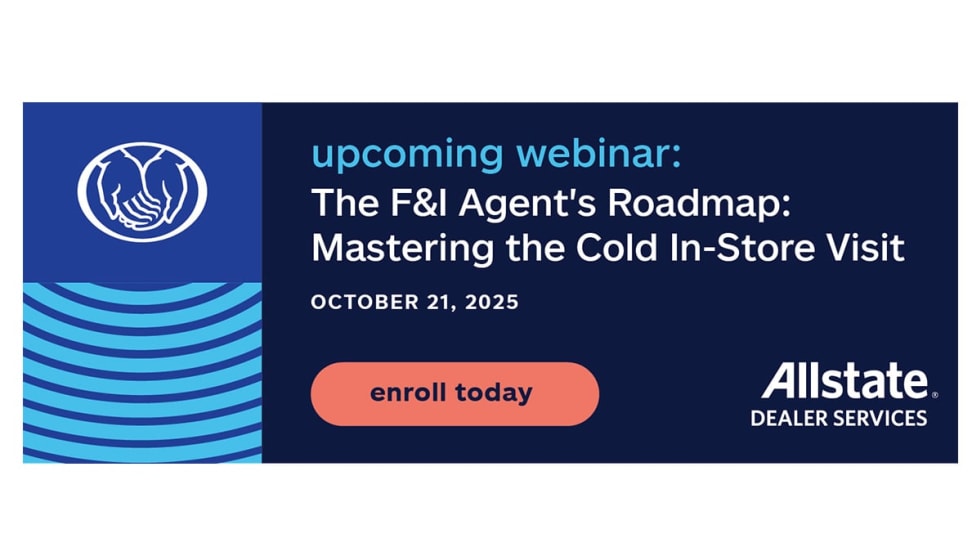
The F&I Agent's Roadmap: Mastering the Cold In-Store Visit
Register for Allstate's FREE webinar on Oct. 21
Read More →
APCO Holdings Acquires DealerPRO Training
The addition expands company's footprint in fixed ops training
Read More →
Auto Dealership Training Program Expands
Protective Asset Protection offering is AI-driven.
Read More →