



AAA Spills the Truth on Oil Changes
The motor club found that synthetic oil performs nearly 50% better than conventional oil in tests. AAA also found, however, that most U.S. drivers are either unsure or do not believe the more expensive synthetic oil is better for a vehicle’s engine.
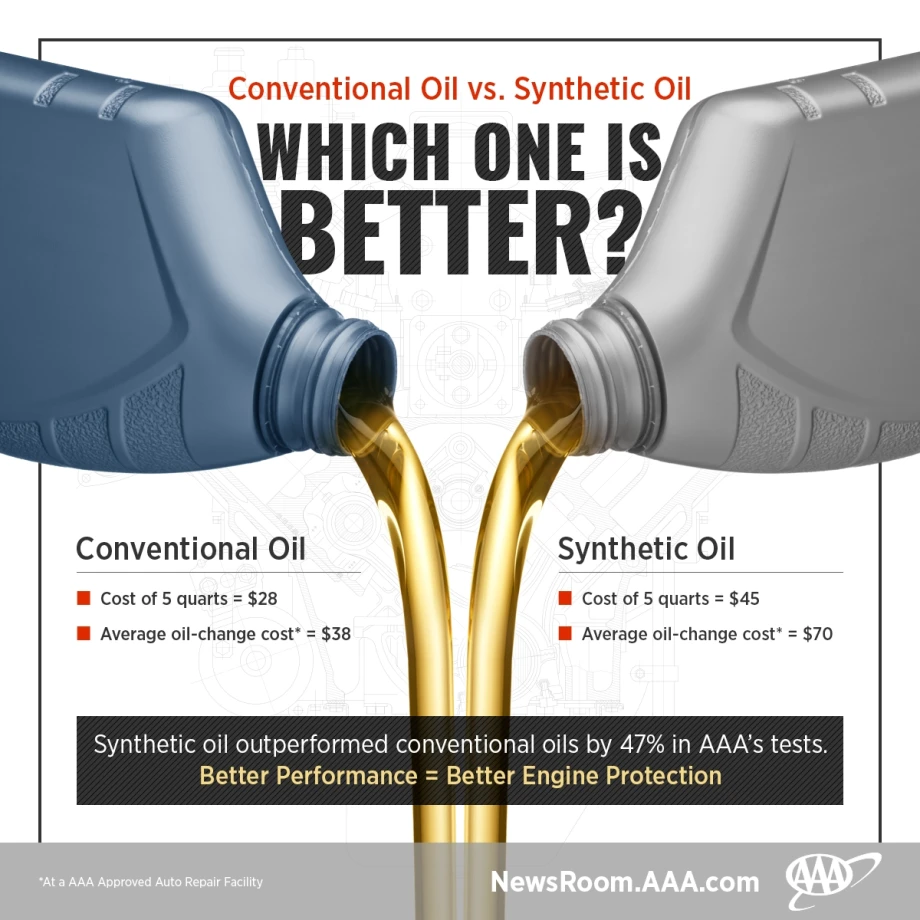
ORLANDO, Fla. — AAA found that synthetic oil outperformed conventional oil by an average of nearly 50% in its independent evaluation, offering vehicles significantly better engine protection for only $5 more per month when following a factory-recommended oil change schedule.
Switching from conventional oil to synthetic oil will cost the average driver $64 more per year, or an extra $5.33 per month. A survey of AAA’s Approved Auto Repair facilities reveals that the average cost of a conventional oil change is $38, while a synthetic oil change is $70. For those that change their vehicle’s oil themselves, the average cost of five quarts of conventional oil is approximately $28, while synthetic oil is $45.
“Oil protects critical engine components from damage and AAA found that synthetic engine oils performed an average of 47% better than conventional oils in a variety of industry-standard tests,” said John Nielsen, AAA’s managing director of Automotive Engineering and Repair. “With its superior resistance to deterioration, AAA’s findings indicate that synthetic oil is particularly beneficial to newer vehicles with turbo-charged engines and for vehicles that frequently drive in stop-and-go traffic, tow heavy loads or operate in extreme hot or cold conditions.”
AAA’s survey also found that vast majority (83%) of service professionals select synthetic oil for their personal vehicles.
In a companion AAA nationwide survey of U.S. drivers, 44% of respondents said they are either unsure (27 percent) or do not believe (17 percent) that the more expensive synthetic oil is better for a vehicle’s engine. Reasons cited for regularly choosing the cheaper, conventional oil include feeling that synthetic oil is too expensive, offers no benefit, that the upgrade to synthetic oil is an unnecessary up-sell by a repair facility, or they are simply not offered the choice.
“It’s understandable that drivers may be skeptical of any service that is nearly twice the cost of the alternative,” Nielsen said. “While manufacturer-approved conventional oil will not harm a vehicle’s engine, the extra $30 per oil change could actually save money in the long run by protecting critical engine components over time.”
The hesitation to select synthetic oil may stem from American distrust in repair facilities. Another recent AAA survey found that two-thirds of U.S. drivers do not trust repair facilities, with most citing concern over the recommendation of unnecessary services.
AAA’s engine oil research focused on eight industry-standard ASTM (American Society for Testing and Materials) tests to evaluate the quality of both synthetic and conventional engine oils in terms of shear stability, deposit formation, volatility, cold-temperature pumpability, oxidation resistance and oxidation-induced rheological changes. At the time of testing, all tested oils were licensed by the American Petroleum Institute and advertised to meet the International Lubricants Standardization and Approval Committee’s GF-5 specifications.
For more, visit www.AAA.com.
Originally posted on F&I and Showroom
More Dealer Ops

How to Avoid Phone Scams | Dealer Debrief 09/10/2026
Are you taking the necessary steps to protect your dealership and customer data from phone-based scams? This week's Dealer Debrief breaks down how!
Read More →
Dealer Debrief: August Auto Sales
Gas-powered engines still dominate the U.S. vehicle market, but hybrids are gaining ground as consumers look for ways to cut their gas costs.
Read More →
Dealership Profits Decline
While new and used retail sales stagnated, dealerships have been particularly supported by fixed operations and finance-and-insurance profits, according to a new report.
Read More →
Dealer Debrief: Defection Data & EV Updates
In this week's debrief, host Lauren Lawrence discusses how to use defection data to your advantage and the latest on EV sales and charging infrastructure.
Read More →
How Defection Data is Bridging the Dealership Conversion Gap
Lead volume is flat, cross-shopping is up and brand loyalty is in retreat. As confident sales teams keep losing buyers they thought they had, daily industry sales data is showing dealers exactly where their funnel is breaking and how to fix it without buying a single new lead.
Read More →
Dealer Debrief: Where are you losing customers?
In this week's debrief, host Lauren Lawrence discusses the hidden leaks in dealerships where you might be losing customers without even realizing it.
Read More →
Dealer Debrief: Improving Your Inventory Management
In this week's debrief, host Lauren Lawrence covers a new survey that shows what service technicians really want and two launches that could help improve your inventory and vehicle life cycle management.
Read More →
Ladies and Gentlemen, This Is a Dealership: Why the Fundamentals Still Decide Who Wins
A teaching moment by a legendary football coach happens to apply perfectly in the auto retail space. Learn what it is and how to use it to your store’s advantage.
Read More →
Dealer Ads and the FTC
The agency has made it clear in recent enforcement actions and warnings, in auto retail and other industries, that advertised prices must include all nonoptional costs to the consumer.
Read More →
Used Autos Supply Dwindles
The March shopping surge, despite high prices, cut into inventory by the most since the thick of the pandemic, Cox Automotive analysts calculated.
Read More →