



Biden Administration Launches Task Force to Address Supply Chain Bottlenecks
President Biden assigned the task force to develop responses for near-term supply challenges in key industries.

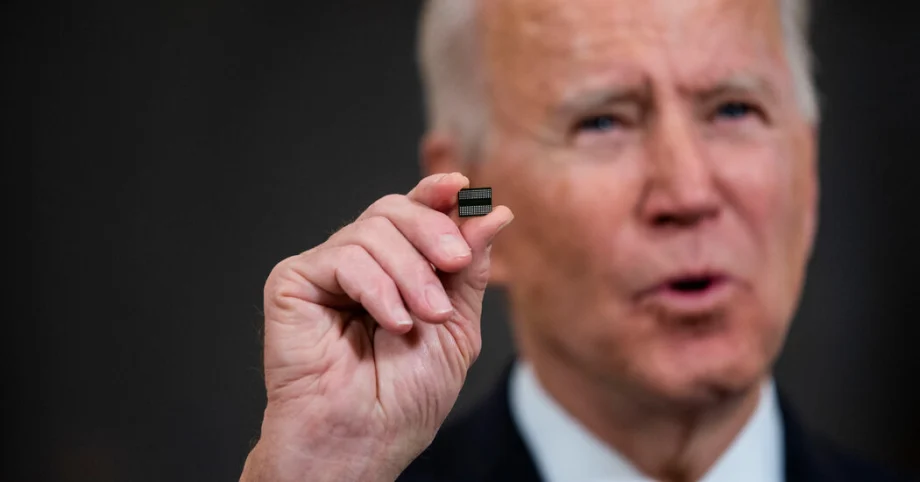
The Department of Commerce will bolster its partnership with industry stakeholders to increase communication and data sharing between semiconductor users and their suppliers.
When the White House released the findings of a 100-day review of critical supply chains, it announced plans to form a new task force aimed at addressing bottlenecks in the semiconductor, construction, transportation, and agriculture sectors.
Led by the secretaries of commerce, transportation and agriculture, the task force will focus on construction, semiconductors, transportation, agriculture and food.
The Administration also promised to take “immediate” steps to secure a domestic supply chain for advanced batteries, develop U.S.-based manufacturing centers for the production and processing of critical minerals, and address the semiconductor shortage with industry stakeholders.
Efforts will help the nation rebuild its manufacturing capabilities for specific products, diversify supply sources for others, and build resiliency and agility into supply chains to avoid future shortages.
“Our approach to supply chain resilience needs to look forward to emerging threats from cybersecurity to climate issues,” said Sameera Fazili, deputy director of the White House National Economic Council in a briefing. “So now we are future proofing.”
The 100-day review, summarized in a 250-page document, stressed that supply chains are critical for national security, economic stability and global leadership, and highlighted how the COVID-19 pandemic exposed U.S. supply chain vulnerabilities. The document also spotlighted how a shortage of raw materials has fueled inflation, that the Administration hopes will be short-lived.
The examination revealed that currently, even if the U.S. were to diversify its sources of critical minerals or increase domestic mining of these minerals, it will still need to rely on China to process them. In addition, heavy reliance on imported parts for large-capacity batteries and semiconductor chips from Asia also creates vulnerabilities.
President Biden directed the review under Executive Order 14017 to assess supply chain vulnerabilities in supply chains. The release of these findings comes as automakers shutter production because of a critical shortage of needed semiconductor chips.
The Administration announced that the Department of Energy (DOE) will release a “National Blueprint for Lithium Batteries” to “codify the findings of the battery supply chain review” and devise a 10-year plan to develop a lithium battery supply chain in the U.S. The DOE will release and discuss this blueprint in an upcoming roundtable.
DOE also will tag some of the $17 billion earmarked for the Advanced Technology Vehicles Manufacturing Program to support the domestic supply chain. The DOE Loan Program’s Office will, for example, provide loans to manufacturers of advanced battery cells and packs to retrofit, expand or establish U.S. manufacturing sites.
In addition, the DOE Energy Management Program will review energy storage to evaluate the “current opportunity for deploying battery storage at federal sites.”
President Biden also tasked the Department of the Interior with developing a multi-agency working group to identify sites that can process critical minerals in the United States. The Department of Defense will supplement that effort with incentives that support production of critical minerals while the U.S. Development Finance Corporation will expand international investment in projects that increase production capacity for critical minerals and other products.
Regarding the semiconductor shortage, the Department of Commerce will bolster its partnership with industry stakeholders to increase communication and data sharing between semiconductor users and their suppliers.
The Administration also has called on Congress to approve $50 billion in investments for domestic manufacturing and R&D development of semiconductors, create incentives for consumers that purchase electric vehicles, establish a supply chain resilience program, finance advance battery production, and expand the use of the Defense Production Act to increase production capacity in critical industries.
More Dealer Ops

How to Avoid Phone Scams | Dealer Debrief 09/10/2026
Are you taking the necessary steps to protect your dealership and customer data from phone-based scams? This week's Dealer Debrief breaks down how!
Read More →
Dealer Debrief: August Auto Sales
Gas-powered engines still dominate the U.S. vehicle market, but hybrids are gaining ground as consumers look for ways to cut their gas costs.
Read More →
Dealership Profits Decline
While new and used retail sales stagnated, dealerships have been particularly supported by fixed operations and finance-and-insurance profits, according to a new report.
Read More →
Dealer Debrief: Defection Data & EV Updates
In this week's debrief, host Lauren Lawrence discusses how to use defection data to your advantage and the latest on EV sales and charging infrastructure.
Read More →
How Defection Data is Bridging the Dealership Conversion Gap
Lead volume is flat, cross-shopping is up and brand loyalty is in retreat. As confident sales teams keep losing buyers they thought they had, daily industry sales data is showing dealers exactly where their funnel is breaking and how to fix it without buying a single new lead.
Read More →
Dealer Debrief: Where are you losing customers?
In this week's debrief, host Lauren Lawrence discusses the hidden leaks in dealerships where you might be losing customers without even realizing it.
Read More →
Dealer Debrief: Improving Your Inventory Management
In this week's debrief, host Lauren Lawrence covers a new survey that shows what service technicians really want and two launches that could help improve your inventory and vehicle life cycle management.
Read More →
Ladies and Gentlemen, This Is a Dealership: Why the Fundamentals Still Decide Who Wins
A teaching moment by a legendary football coach happens to apply perfectly in the auto retail space. Learn what it is and how to use it to your store’s advantage.
Read More →
Dealer Ads and the FTC
The agency has made it clear in recent enforcement actions and warnings, in auto retail and other industries, that advertised prices must include all nonoptional costs to the consumer.
Read More →
Used Autos Supply Dwindles
The March shopping surge, despite high prices, cut into inventory by the most since the thick of the pandemic, Cox Automotive analysts calculated.
Read More →