



Black Book Used Vehicle Retention Index Increases 0.7 Points in November
The seasonally adjusted Index increased slightly from October, with raw index values declining less than usual for this time of year.

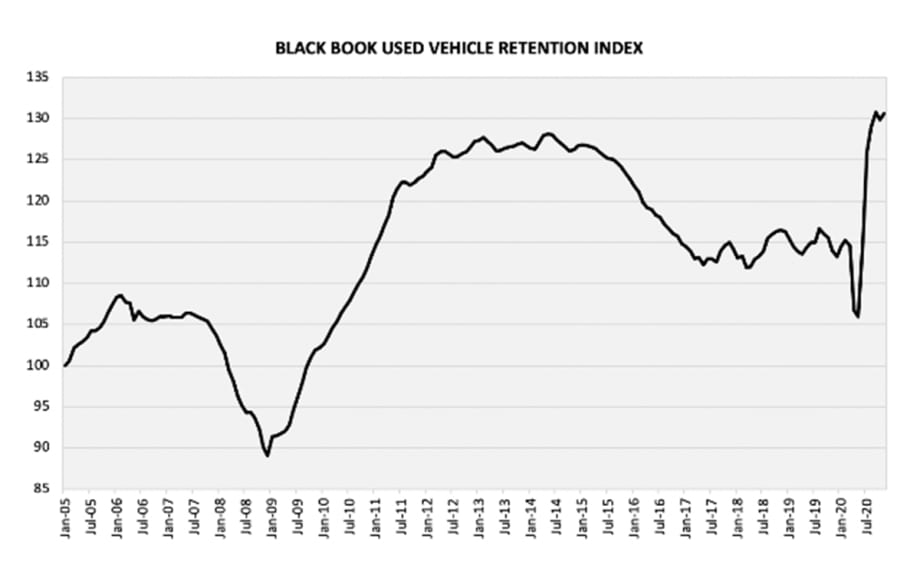
The seasonally adjusted Index increased slightly from October, with raw index values declining less than usual for this time of year.
IMAGE: Black Book
LAWRENCEVILLE, Georgia — Black Book, a division of Hearst that provides industry-leading used vehicle valuation and residual value forecast solutions, released its Used Vehicle Retention Index for November 2020 (130.6), a 0.7-point increase from October (129.9). Click here to obtain a copy of the latest index data.
We project the weakening of most of the segments this winter, including Full-size Pickups, without a substantial second Federal stimulus as the economy remains weak and there is an expected increase of used supply.
“The Market Level Index increased slightly in November,” said Alex Yurchenko, Senior Vice President, Data Science. “Most of the segments depreciated at a slower rate than we have seen in the past at this time of the year. The Wholesale market is still adjusting to shortages of supply due to abnormally low repossession rates, low levels of rental units remarketing (as rental fleet companies were able to right-size their inventory prior to October), and a decrease of trade-in volume at the auctions (as dealers kept more of that inventory outside of wholesale market). We project the weakening of most of the segments this winter, including Full-size Pickups, without a substantial second Federal stimulus as the economy remains weak and there is an expected increase of used supply.”
The Black Book Used Vehicle Retention Index is calculated using Black Book’s published Wholesale Average value on two- to six-year-old used vehicles, as percent of original typically-equipped MSRP. It is weighted based on registration volume and adjusted for seasonality, vehicle age, mileage, and condition. The Index offers an accurate, representative, and unbiased view of the strength of today’s used vehicle market values.
The Index dates to January 2005, where Black Book published a benchmark index value of 100.0 for the market. During 2008, the index dropped by 14.1% while during 2016, the index fell by just 6.4%. During 2011, the index rose strongly from 113.3 to 123.0 by the end of the year as the economy picked up steam and used vehicle values rose higher. It continued to remain relatively stable, rising slightly until May of 2014 when it hit a peak of 128.1.
To obtain a copy of the latest Black Book Wholesale Value Index, please click here.
More Dealer Ops

How to Avoid Phone Scams | Dealer Debrief 09/10/2026
Are you taking the necessary steps to protect your dealership and customer data from phone-based scams? This week's Dealer Debrief breaks down how!
Read More →
Dealer Debrief: August Auto Sales
Gas-powered engines still dominate the U.S. vehicle market, but hybrids are gaining ground as consumers look for ways to cut their gas costs.
Read More →
Dealership Profits Decline
While new and used retail sales stagnated, dealerships have been particularly supported by fixed operations and finance-and-insurance profits, according to a new report.
Read More →
Dealer Debrief: Defection Data & EV Updates
In this week's debrief, host Lauren Lawrence discusses how to use defection data to your advantage and the latest on EV sales and charging infrastructure.
Read More →
How Defection Data is Bridging the Dealership Conversion Gap
Lead volume is flat, cross-shopping is up and brand loyalty is in retreat. As confident sales teams keep losing buyers they thought they had, daily industry sales data is showing dealers exactly where their funnel is breaking and how to fix it without buying a single new lead.
Read More →
Dealer Debrief: Where are you losing customers?
In this week's debrief, host Lauren Lawrence discusses the hidden leaks in dealerships where you might be losing customers without even realizing it.
Read More →
Dealer Debrief: Improving Your Inventory Management
In this week's debrief, host Lauren Lawrence covers a new survey that shows what service technicians really want and two launches that could help improve your inventory and vehicle life cycle management.
Read More →
Ladies and Gentlemen, This Is a Dealership: Why the Fundamentals Still Decide Who Wins
A teaching moment by a legendary football coach happens to apply perfectly in the auto retail space. Learn what it is and how to use it to your store’s advantage.
Read More →
Dealer Ads and the FTC
The agency has made it clear in recent enforcement actions and warnings, in auto retail and other industries, that advertised prices must include all nonoptional costs to the consumer.
Read More →
Used Autos Supply Dwindles
The March shopping surge, despite high prices, cut into inventory by the most since the thick of the pandemic, Cox Automotive analysts calculated.
Read More →