



Black Book’s Used Vehicle Retention Index Drops for the First Time Since July of 2021
The seasonally adjusted Retention Index went down to 187.7 points in March 2022 as modified Spring arrives late.

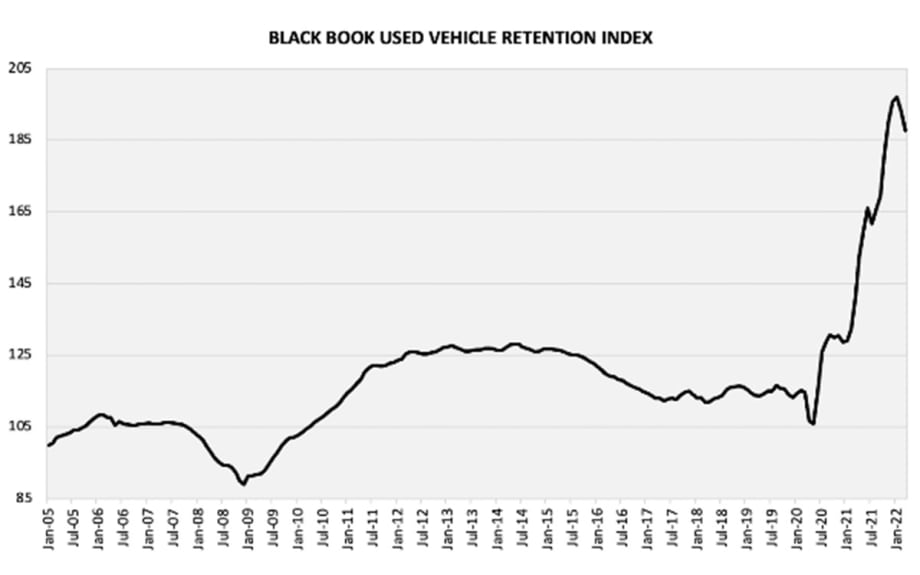
The seasonally adjusted Retention Index went down to 187.7 points in March 2022 as modified Spring arrives late.
IMAGE: Black Book
LAWRENCEVILLE, Georgia – Black Book, a division of Hearst that provides industry-leading used vehicle valuations and residual value forecast solutions, released its Used Vehicle Retention Index for March 2022. The Index decreased to 187.7, a 5.3-point (or 2.8%) dr op. The Index currently stands 33% above where it was at the same time in 2021 and 64% above March 2020 (just as the pandemic started).
“In March, we saw another decline of wholesale prices in all but two (Full-Size and Compact Vans) 2-8-year-old vehicle segments that comprise of Black Book’s Retention Index. In pre-COVID years, we would have expected the market to gain strength across many segments by the end of March as dealers were accelerating their tax-season buying,” said Alex Yurchenko, Chief Data Scie nce Officer at Black Book. “So far, only a few segments showed increases (e.g. Compact Car and Compact Crossover) due to tax season and elevated gas prices.
“The spring tax season is usually strongest for cheaper vehicles, but with wholesale values reporting a record 28.7% increase in 2021, dealers are having to look at even older model years to purchase in the “sweet spot” for their tax season shoppers – we observed overall market price increases for 8-16-year-old vehicles.
The main uncertainty remains on the demand side of the equation: raising interest rates, low consumer confidence, the Russian invasion of Ukraine, high gas prices, and inflation concerns are the main factors that have a large impact on consumer behavior. Even with supply chain issues still putting the brakes on new vehicle sales and with record low incentives, we are expecting a moderate decline in prices during the next several months.”
The Black Book Used Vehicle Retention Index is calculated using Black Book’s published Wholesale Average value on two- to six-year-old used vehicles, as percent of original typically equipped MSRP. It is weighted based on registration volume and adjusted for seasonality, vehicle age, mileage, and condition. The Index offers an accurate, representative, and unbiased view of the strength of today’s used vehicle market values.
To obtain a copy of the latest Black Book Wholesale Value Index, click here.
More Dealer Ops

How to Avoid Phone Scams | Dealer Debrief 09/10/2026
Are you taking the necessary steps to protect your dealership and customer data from phone-based scams? This week's Dealer Debrief breaks down how!
Read More →
Dealer Debrief: August Auto Sales
Gas-powered engines still dominate the U.S. vehicle market, but hybrids are gaining ground as consumers look for ways to cut their gas costs.
Read More →
Dealership Profits Decline
While new and used retail sales stagnated, dealerships have been particularly supported by fixed operations and finance-and-insurance profits, according to a new report.
Read More →
Dealer Debrief: Defection Data & EV Updates
In this week's debrief, host Lauren Lawrence discusses how to use defection data to your advantage and the latest on EV sales and charging infrastructure.
Read More →
How Defection Data is Bridging the Dealership Conversion Gap
Lead volume is flat, cross-shopping is up and brand loyalty is in retreat. As confident sales teams keep losing buyers they thought they had, daily industry sales data is showing dealers exactly where their funnel is breaking and how to fix it without buying a single new lead.
Read More →
Dealer Debrief: Where are you losing customers?
In this week's debrief, host Lauren Lawrence discusses the hidden leaks in dealerships where you might be losing customers without even realizing it.
Read More →
Dealer Debrief: Improving Your Inventory Management
In this week's debrief, host Lauren Lawrence covers a new survey that shows what service technicians really want and two launches that could help improve your inventory and vehicle life cycle management.
Read More →
Ladies and Gentlemen, This Is a Dealership: Why the Fundamentals Still Decide Who Wins
A teaching moment by a legendary football coach happens to apply perfectly in the auto retail space. Learn what it is and how to use it to your store’s advantage.
Read More →
Dealer Ads and the FTC
The agency has made it clear in recent enforcement actions and warnings, in auto retail and other industries, that advertised prices must include all nonoptional costs to the consumer.
Read More →
Used Autos Supply Dwindles
The March shopping surge, despite high prices, cut into inventory by the most since the thick of the pandemic, Cox Automotive analysts calculated.
Read More →