



Wholesale Used-Vehicle Prices Increase in First Half of July From Seasonal Adjustment
Over the last two weeks, Manheim Market Report prices saw higher-than-normal but decelerating declines.

Over the last two weeks, Manheim Market Report prices saw higher-than-normal but decelerating declines.
MAHEIM – Wholesale used-vehicle prices (on a mix-, mileage-, and seasonally adjusted basis) increased 0.7% from June in the first 15 days of July. The Manheim Used Vehicle Value Index rose to 221.5, which was up 13.4% from July 2021. The non-adjusted price change in the first half of July was a decrease of 2.2% compared to June, leaving the unadjusted average price up 11.4% year over year.
Over the last two weeks, Manheim Market Report (MMR) prices saw higher-than-normal but decelerating declines. Over that time, the Three-Year-Old MMR Index, which represents the largest model-year cohort at auction, experienced a 1.5% cumulative decline. Over the first 15 days of July, MMR Retention, which is the average difference in price relative to current MMR, averaged 97.8%, which indicates that valuation models are ahead of market prices. The average daily sales conversion rate of 46.7% in the first half of July declined relative to June’s daily average of 51.3% and has been lower than the typical conversion rate this time of year. The latest trends in key indicators suggest wholesale used-vehicle values should see declines in the second half of the month.
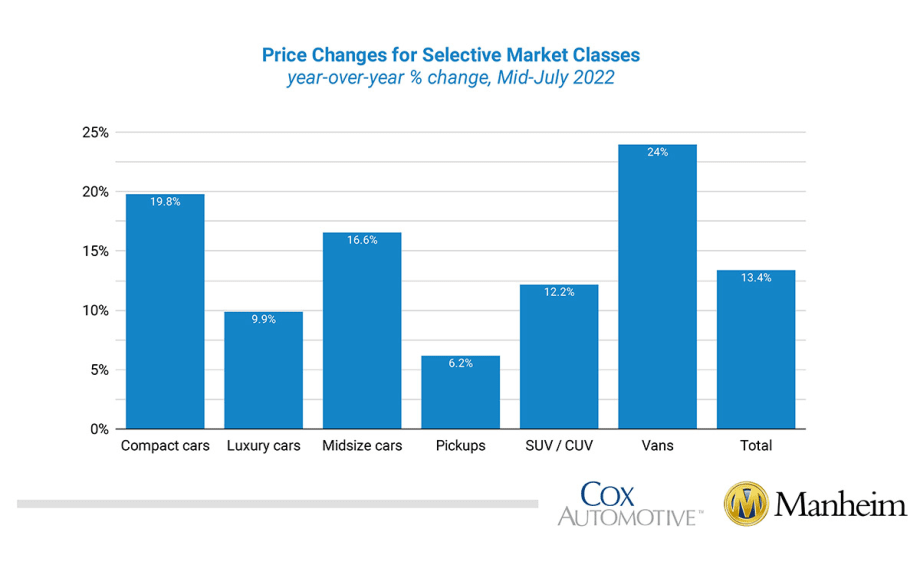
All major market segments saw seasonally adjusted prices that were higher year over year in the first half of July. Vans had the largest increase at 24.0%, while both non-luxury car segments again outpaced the overall industry in seasonally adjusted year-over-year gains. Compared to June, four of eight major segments saw better performance, with compact, full-size, and midsize cars up 2.2%, 1.9%, and 1.7%, respectively. The seasonal adjustment drove the increases, with SUVs up a slight 0.2% from June, while pickups and vans decreased 0.4% and 0.7%, respectively.
Retail and wholesale days’ supply relative normal at mid-July. Using estimates based on vAuto data as of July 11, used retail days’ supply was 47 days, which was down two days from the end of June. Days’ supply was up eight days year over year but at the same level for the same week in 2019. Leveraging Manheim sales and inventory data, we estimate that wholesale supply ended June at 26 days, up one day from the end of May and up six days year over year. As of July 15, wholesale supply was at 27 days, up one day from the end of June and up six days year over year but three days lower than 2019.
Rental risk prices maintain year-over-year increase. The average price for rental risk units sold at auction in the first 15 days of July was up 32.9% year over year. Rental risk prices were up 0.3% compared to the full month of June. Average mileage for rental risk units in the first half of July (at 57,800 miles) was down 34.4% compared to a year ago and down 1.6% month over month.
Consumer Sentiment increases to start July. The initial July reading on Consumer Sentiment from the University of Michigan increased 2.2% to 51.1. The improvement was from consumers’ view of current conditions as future expectations declined slightly. Also notable, the expected inflation rate in five years fell to 2.8% from 3.1% in June. Consumers’ views of buying conditions for vehicles increased to the best level since April. The daily index of consumer sentiment from Morning Consult has also increased so far in July. The index is up 0.3% for the month so far. Sentiment has improved as gas prices have been falling. The average price of unleaded nationally was $4.52 on Sunday, down 9.9% from peak in June.
Originally posted on F&I and Showroom
More Dealer Ops

How to Avoid Phone Scams | Dealer Debrief 09/10/2026
Are you taking the necessary steps to protect your dealership and customer data from phone-based scams? This week's Dealer Debrief breaks down how!
Read More →
Dealer Debrief: August Auto Sales
Gas-powered engines still dominate the U.S. vehicle market, but hybrids are gaining ground as consumers look for ways to cut their gas costs.
Read More →
Dealership Profits Decline
While new and used retail sales stagnated, dealerships have been particularly supported by fixed operations and finance-and-insurance profits, according to a new report.
Read More →
Dealer Debrief: Defection Data & EV Updates
In this week's debrief, host Lauren Lawrence discusses how to use defection data to your advantage and the latest on EV sales and charging infrastructure.
Read More →
How Defection Data is Bridging the Dealership Conversion Gap
Lead volume is flat, cross-shopping is up and brand loyalty is in retreat. As confident sales teams keep losing buyers they thought they had, daily industry sales data is showing dealers exactly where their funnel is breaking and how to fix it without buying a single new lead.
Read More →
Dealer Debrief: Where are you losing customers?
In this week's debrief, host Lauren Lawrence discusses the hidden leaks in dealerships where you might be losing customers without even realizing it.
Read More →
Dealer Debrief: Improving Your Inventory Management
In this week's debrief, host Lauren Lawrence covers a new survey that shows what service technicians really want and two launches that could help improve your inventory and vehicle life cycle management.
Read More →
Ladies and Gentlemen, This Is a Dealership: Why the Fundamentals Still Decide Who Wins
A teaching moment by a legendary football coach happens to apply perfectly in the auto retail space. Learn what it is and how to use it to your store’s advantage.
Read More →
Dealer Ads and the FTC
The agency has made it clear in recent enforcement actions and warnings, in auto retail and other industries, that advertised prices must include all nonoptional costs to the consumer.
Read More →
Used Autos Supply Dwindles
The March shopping surge, despite high prices, cut into inventory by the most since the thick of the pandemic, Cox Automotive analysts calculated.
Read More →