



Black Book’s Used Vehicle Retention Index Drops for the First Time Since July of 2021
Seasonally adjusted Retention Index down to 193.0 points in February of 2022 as questions about the strength of the upcoming Spring market remain.

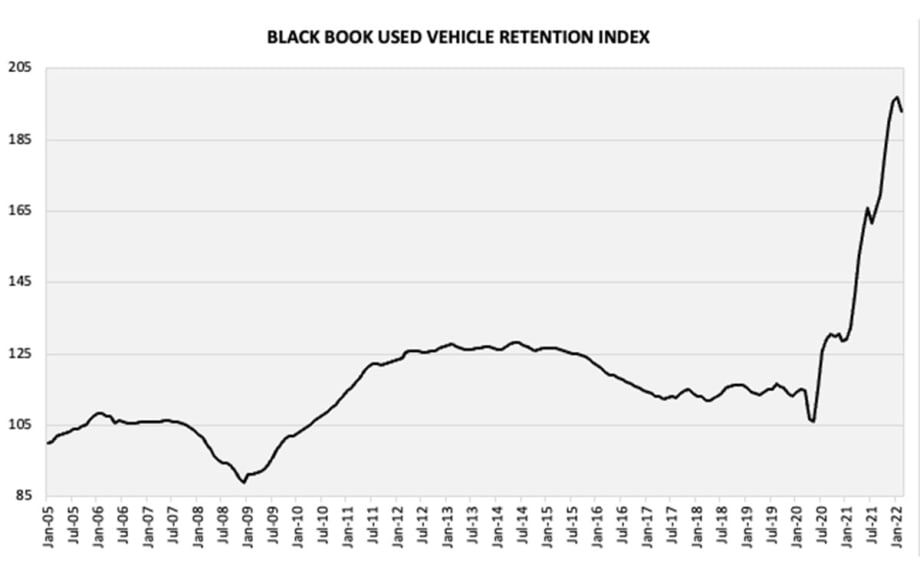
Seasonally adjusted Retention Index down to 193.0 points in February of 2022 as questions about the strength of the upcoming Spring market remain.
LAWRENCEVILLE, Georgia – Black Book, a division of Hearst that provides industry-leading used vehicle valuations and residual value forecast solutions, today released its Used Vehicle Retention Index for February 2022. For the first time since last summer, the Index decreased by 4.0 points (or 2.0%) to 193.0 points. The Index currently stands 68% above where it was at the same time in 2021 and 46% above February 2020 (just before the pandemic started).
“In February, we saw an accelerated decline of wholesale prices in all but two (Full-Size and Compact Vans) segments. That led to a decrease in the overall monthly seasonally adjusted retention index,” said Alex Yurchenko, Chief Data Science Officer at Black Book. “So far, it looks like the tax season boost to the retail demand is weaker than in a typical pre-pandemic year. We still expect a slower rate of decrease in prices in May with possible appreciation is some segments as the spring buying market arrives.”
The Black Book Used Vehicle Retention Index is calculated using Black Book’s published Wholesale Average value on two- to six-year-old used vehicles, as percent of original typically equipped MSRP. It is weighted based on registration volume and adjusted for seasonality, vehicle age, mileage, and condition. The Index offers an accurate, representative, and unbiased view of the strength of today’s used vehicle market values.
To obtain a copy of the latest Black Book Wholesale Value Index, please click here.
Originally posted on Agent Entrepreneur
More Dealer Ops

Ladies and Gentlemen, This Is a Dealership: Why the Fundamentals Still Decide Who Wins
A teaching moment by a legendary football coach happens to apply perfectly in the auto retail space. Learn what it is and how to use it to your store’s advantage.
Read More →
Timing the Market Can Hurt Long-Term Program Performance
For dealer-owned reinsurance entities, avoiding volatility entirely can mean falling behind inflation and missing market rebounds that drive long term surplus growth. Missing just a handful of strong market days can materially impact cumulative returns—an important reminder for long horizon trust and investment strategies.
Read More →
Dealer Ads and the FTC
The agency has made it clear in recent enforcement actions and warnings, in auto retail and other industries, that advertised prices must include all nonoptional costs to the consumer.
Read More →
Used Autos Supply Dwindles
The March shopping surge, despite high prices, cut into inventory by the most since the thick of the pandemic, Cox Automotive analysts calculated.
Read More →
Managing Risk Effectively Through Changing Times
The variables influencing risk pricing have changed significantly over the past five years. Being proactive and responsive to emerging trends is not optional but essential.
Read More →
Survey Reveals What Won't Fix What's Breaking Car Sales
AutoPayPlus says extra-long auto loans are trapping consumers and threatening the dealer trade-in cycle, and that the industry is leveraging the wrong tools to combat high MSRPs.
Read More →
IA American Appoints Two Execs
Senior vice presidents of the company's agent and dealer channels chosen to support general agents and help auto dealers with sales and performance.
Read More →
Cox Automotive Acquires Inspection Firm
Full ownership of Alliance Inspection Management, or AiM, meant to unlock growth for Manheim inspection capabilities
Read More →
Assurant Expands Partnership With Holman
Extended collaboration delivers training, products and performance development to 30 newly acquired Holman dealerships
Read More →
Franchises, Throughput Down in First Half
A handful of states see franchise growth through June, while EV sales per store boost overall business in U.S.
Read More →