



EVs Likely to Survive Losses
Hit from curtailing of government incentives elsewhere proved short-lived.

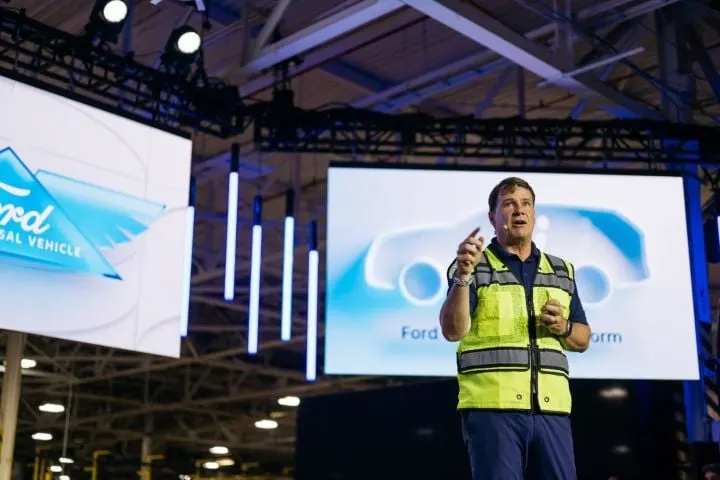
Ford CEO Jim Farley announcing in August a new assembly structure for the automaker's EVs.
Ford
Though the outlook for electric-vehicle sales has been dimming, one market watcher foresees only a temporary slowdown in adoption.
Based on patterns seen earlier in other countries, the end of government subsidies adopted to encourage EV sales shouldn’t be the death of the segment, J.D. Power analysts predict.
EV adoption in the U.S. faces a raft of obstacles erected by the Trump administration, including the Oct. 1 end of federal tax credits, weaker vehicle emissions restrictions, and scuttling of multiple states’ gas-powered car sale bans next decade. California, which leads the country in EV sales, said it won’t fill the tax credit gap by resuming its own subsidy.
U.S. EV adoption already lagged that of other countries and regions, slowed in part by limited charging infrastructure in more rural areas. But the loss of incentives stands to slow its progress. Given lower demand than anticipated, automakers had pulled back from plans just a few years ago to convert their entire lineups to electrified models, though they haven’t abandoned EVs, by any means. In fact, Ford recently announced a new assembly line structure for EV production, along with dealership chargers open to the general driving public.
However, based on EV adoption evolution in some other countries, the loss of government incentives shouldn’t threaten sales in the longer-term, according to analysis by J.D. Power. When national EV subsidies were phased out in both Canada and Germany, for instance, it said sales quickly sank but then gradually started returning to normal levels.
“… we see a fairly predictable trend in supply-demand dynamics taking root in the U.S. market,” J.D. Power said in its report.
Its research shows that U.S. consumer interest in EVs hasn’t wavered. Of those looking to buy or lease in the next 12 months, 59% say they’re very or somewhat likely to consider EVs, similar to interest levels over the past year.
Just the knowledge that the federal tax credit will expire drove many to buy or lease electric in recent months. In August, EVs’ new-vehicle retail market share tied December’s single-month record of 11%, up from 8% in May, J.D. Power said.
Still, consumers are price-conscious in today’s inflated market. Among those unlikely to go electric, 45% said price is a top factor in their hesitation, up three percentage points from July.
LEARN MORE: EVs Undergo Crash Tests With Mixed Results
More Industry

U.S. EV Market Update | Dealer Debrief
The U.S. electric vehicle market is slowly recovering from the loss of the federal EV tax credit last fall. Learn more in this week's Dealer Debrief!
Read More →
Auto Finance Numbers Set Records
Third-quarter data show how consumers are adapting to ongoing affordability challenges facing the new- and-used-vehicle markets.
Read More →
Auto Dealerships Can’t Afford to Ignore the 50+ Consumer
Younger generations may be all the buzz today when it comes to product marketing targets, but their older cohorts command a sizable share of purchasing power.
Read More →
Savings Seekers Boost U.S. Automakers’ Rivals
As consumers here look for ways to curb inflation’s affect on their budgets, brands offering plenty of alternative powertrains are closing in on home-grown OEMs.
Read More →
The Slow Electric Ascent
Second-quarter data show that the electric-vehicle market in the U.S. is inching up, the majority of states seeing a month-over-month increase.
Read More →
Safer Rides & Cyberattacks
Vehicle crash testing is getting a virtual boost, but auto dealerships are facing increased cyberattacks. Learn more in this week's Dealer Debrief!
Read More →
Affordability Angst | Dealer Debrief
August saw little relief for car buyers, whether they were shopping new or used. Take a look at the month's breakdown in this week's Dealer Debrief!
Read More →
Virtual Crash Testing in the Works
A company's platform works alongside physical crash testing to gather insights into occupant response and injury mechanisms, with the idea of helping automakers develop safer vehicles.
Read More →
Tariff Tiff Examined
Some auto industry leaders are taking a relaxed view of the U.S.-Canada trade war while others worry that a dramatically adjusted playing field could mean too much collateral damage.
Read More →
EV Consideration Climbs
Despite the loss of federal EV incentives, interest has grown in the U.S., largely thanks to charging infrastructure improvements.
Read More →