



Is It Time to Sell My Dealership?
Former dealer opens up about the sale of his auto group and urges colleagues to consider the transactional demands of a sale and the emotional impact of unwinding yourself from the business you have built.

A healthy economy and sustained levels of M&A activity are forcing U.S. auto dealers to ponder the market for their businesses and the financial and psychological implications of a post-dealership life.
Photo by razerbird via Getty Images
Every dealer has fantasized about a highly successful exit. After a lifetime preoccupied with building the business, it can be difficult to imagine a life without it. Initially, dealers typically apply a quick financial analysis to the decision. They make an assessment of their dealership’s market value and evaluate their current lifestyle and the cost of maintaining it. They then consider the range of potential investment returns on their new post-sale cash position, then attempt to reconcile their available investable cash with lifestyle maintenance, and then go back to selling cars.
The sales activity in the franchise dealership world these past few years shows that many dealers have taken this analysis further than just fantasy. Dealers indulge themselves by asking, “Wouldn’t it be nice to mitigate the risk of running the business?” or “Wouldn’t it be prudent to take some money off the table and relieve the worries about the financial future?”
Many industry participants believe that we are approaching the end of the current upcycle in the economy and the car business, and that the time to sell is now.
With today’s automotive franchise dealerships under attack on multiple fronts, the future is increasingly difficult to predict. Ten years ago, most of the dealers in business today survived the worst economic crisis since the Great Depression. They are a resourceful, resilient group. So the question is not whether you can survive the next downturn, but whether it is worth the risk.
There Is a Market for Your Store
In 2007, financial markets were primed for a massive crisis, but governments were able to draw heavily on their monetary, fiscal, and diplomatic resources to prevent that crisis from destroying the global economy. Today the financial dominoes are not set up quite so precariously. But in many ways, the broader economic and political environment is equally foreboding. It might not take much to bring on the next recession, and the recovery could take seven or eight years as it did following the Great Recession.
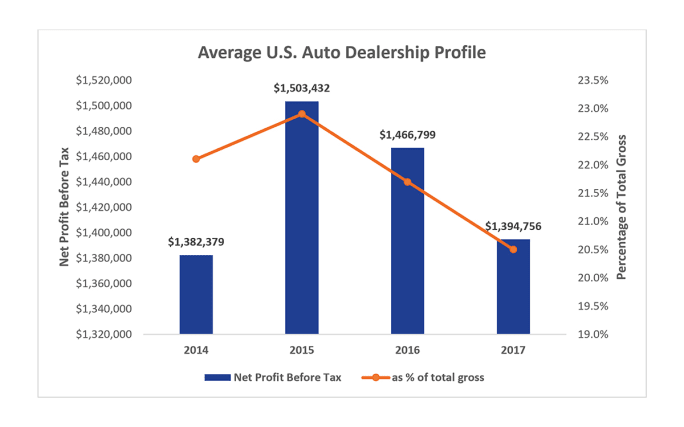
Source: NADA
With all of the uncertainty in the global economic future, there is some reaffirming news to consider as it relates to dealership valuations. Although it is impossible to predict the best economic time to sell, the current environment remains favorable for selling dealership assets.
In spite of slightly declining dealership pretax profits, merger and acquisition activity is on the rise. The Banks Report found a 23% increase in dealerships sold in the first half of 2018 over the same period in 2017, and blue-sky multiples have been relatively constant year over year.
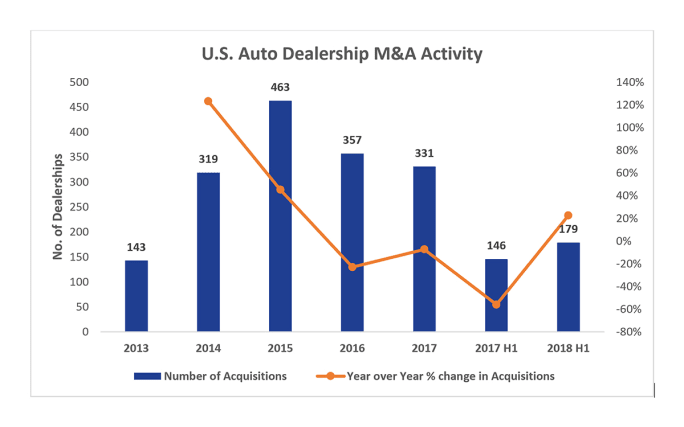
Source: The Banks Report
It is fair to postulate, at least in part, that these indicators have been influenced by lower taxes and the success of other asset classes currently trading at higher multiples. What is more difficult to establish is how long this environment will remain positive.
Draw Up a Game Plan
After weighing the financial pros and cons of selling one or more rooftops, the biggest nonfinancial issue may be the psychological impacts of the dealer removing themselves from a business that has been an essential part of their identity for years or decades. Notwithstanding all of the aforementioned analysis, it becomes apparent that there is much more to consider than economic conditions when deliberating over whether to sell.
From a financial perspective, the game plan for selling is clear: Start by getting a well-researched estimate of value of your dealership. Then begin the work to make improvements to position your asset for sale in the best light.
The seller can preempt challenges from a prospective buyer by performing a self-analysis and making the appropriate changes. Not too far removed from our basic sales training, the seller benefits from anticipating and overcoming objections before they are raised. Whether performed internally or by third-party consultants, the self-analysis should be focused on the very components you would evaluate prior to making a purchase.
Some of the more obvious improvements include:
• Expense reduction.
• Increasing parts and service absorption.
• Delivering favorable real estate terms.
• Delivering a clean inventory.
Of course, a competent, stable management team remains a key indicator of organizational effectiveness. All those factors aside, the value of a dealership is not always a quantifiable, tangible amount. Perception of value and the benefits of ownership are unique to each buyer. Painting a compelling picture by conveying the right presentation can be a major determinant in a sale. Some often overlooked and cost-effective actions than can generate significant additional value include:
• You must deliver reliable financial reporting. Any financial statements delivered to prospective buyers should be free of any unique or idiosyncratic entries. Be able to identify positive trends and areas for growth.
• Review internal control documents to make certain you can provide complete records of all legal documents pertaining to dealership operations, including, but not limited to licenses, permits, loan agreements, pay plans, and real and personal property leases.
• Having a complete, detailed customer list available, in a useable format, for the subsequent owner to be able to easily contact customers. This list is of great value and is reassuring to the new dealer. It will help control initial advertising costs, make overall performance more predictable, and provide assurance that previous margins are maintainable.
• Within reason, bring compliance with your manufacturer’s image program current. Leaving the buyer with a foreboding list of required image changes can devalue your dealership and prove to dissuade a buyer from proceeding with the acquisition.
Next, develop a marketing plan, including perhaps hiring a dealership M&A advisor. Perform creative tax planning with professional advisors. And finally, determine your method of post-transaction wealth management.

Selling a dealership requires the preparation of key documents and reports pertaining to financial health, your customer list, and compliance with factory image requirements.
Photo by 12875116 via Getty Images
Prepare for Your Next Challenge
In preparation for the emotional aspect of the sale it is worthwhile to have an after-dealership plan for day-to-day life. The question seems to boil down to this: After a lifetime of designing a life around building a business, can a dealer flourish through this transition and reinvent themselves for the next phase of life? The self-esteem of business ownership, maintaining a rewarding lifestyle, and personal wealth are all intertwined into a complex dynamic.
Most successful dealers are goal-oriented businessmen who constantly strive to improve their dealership and their lives. Selling that dealership should not necessarily impair that drive to achieve. With good planning and execution, this simply means that dealers will have shifted their goals by liquidating one or more important assets and redirecting their drive for future success in other arenas.
Like most dealers, I had a strong connection to my dealerships. The businesses became more than financial platforms. They became a principal source of purpose and self-esteem. They provided the impetus for charitable giving, community involvement, a comfortable lifestyle, and the source of funding for other investments.
I sold my dealerships just prior to the last economic downturn. My timing was fortuitous. I was able to separate my emotions and the sense of loss from what turned out to be a sound financial decision. Notwithstanding my good luck with timing, I failed to prepare a sound, comprehensive exit strategy that considered life after sale. My plan ended when escrow closed. After a lifetime of working toward very specific goals, I found myself missing a major driving force in my life.
An imminent economic retrenchment is foreseeable. While economic expansions don’t die of old age, there are killers lurking in the shadows. There are no records of expansions lasting longer than 10 years in the U.S. After careful analysis, you may determine that this is the right time for you to sell to secure your financial future.
I believe that there is a convergence of economic and political events suggesting that now is the time to strongly consider monetizing dealership assets in tax-efficient transactions. If that is your decision, don’t second-guess it.
Instead, design a well-thought-out blueprint that includes presale dealership preparation, tax planning, a post-transaction investment strategy and a forward-looking emotional understanding that enables you to embrace the next stage in life with the same zeal that built your businesses.
Finally, give equal consideration to the financial aspects of the sale and a self-awareness that fulfills your emotional wellbeing. Make sure your own plan goes beyond the closing of escrow.
Marc Spizzirri is senior managing director for GlassRatner Advisory & Capital Group LLC (div. B. Riley Financial Inc.) and the former owner and president of Family Automotive Group.
More Dealer Ops
How to Avoid Phone Scams | Dealer Debrief 09/10/2026
Are you taking the necessary steps to protect your dealership and customer data from phone-based scams? This week's Dealer Debrief breaks down how!
Read More →
Dealer Debrief: August Auto Sales
Gas-powered engines still dominate the U.S. vehicle market, but hybrids are gaining ground as consumers look for ways to cut their gas costs.
Read More →
Dealership Profits Decline
While new and used retail sales stagnated, dealerships have been particularly supported by fixed operations and finance-and-insurance profits, according to a new report.
Read More →
Dealer Debrief: Defection Data & EV Updates
In this week's debrief, host Lauren Lawrence discusses how to use defection data to your advantage and the latest on EV sales and charging infrastructure.
Read More →
How Defection Data is Bridging the Dealership Conversion Gap
Lead volume is flat, cross-shopping is up and brand loyalty is in retreat. As confident sales teams keep losing buyers they thought they had, daily industry sales data is showing dealers exactly where their funnel is breaking and how to fix it without buying a single new lead.
Read More →
Dealer Debrief: Where are you losing customers?
In this week's debrief, host Lauren Lawrence discusses the hidden leaks in dealerships where you might be losing customers without even realizing it.
Read More →
Dealer Debrief: Improving Your Inventory Management
In this week's debrief, host Lauren Lawrence covers a new survey that shows what service technicians really want and two launches that could help improve your inventory and vehicle life cycle management.
Read More →
Ladies and Gentlemen, This Is a Dealership: Why the Fundamentals Still Decide Who Wins
A teaching moment by a legendary football coach happens to apply perfectly in the auto retail space. Learn what it is and how to use it to your store’s advantage.
Read More →
Dealer Ads and the FTC
The agency has made it clear in recent enforcement actions and warnings, in auto retail and other industries, that advertised prices must include all nonoptional costs to the consumer.
Read More →
Used Autos Supply Dwindles
The March shopping surge, despite high prices, cut into inventory by the most since the thick of the pandemic, Cox Automotive analysts calculated.
Read More →