



Black Book Used Vehicle Retention Index Decreases in December
There were 4 months of typical seasonal decline in prices, resulting in a relatively flat seasonally adjusted index.

There were 4 months of typical seasonal decline in prices, resulting in a relatively flat seasonally adjusted index.
IMAGE: Black Book
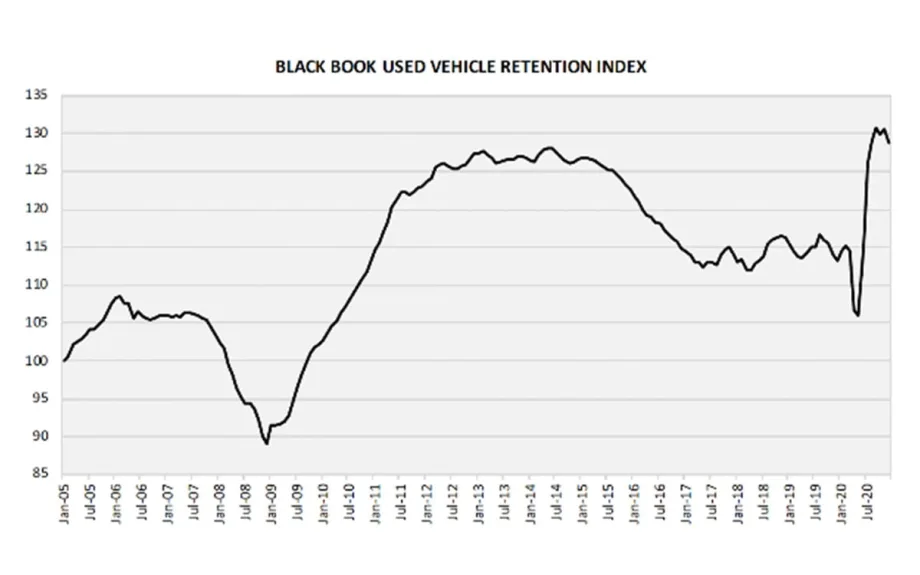
LAWRENCEVILLE, Ga. – Black Book, a division of Hearst that provides industry-leading used vehicle valuation and residual value forecast solutions, released its Used Vehicle Retention Index for December 2020 (128.8), a 1.8 point decline from November (130.6). Click here to obtain a copy of the latest index data.
“The seasonally adjusted Retention Index has remained relatively stable since August,” said Alex Yurchenko, SVP, Data Science. “Nevertheless, due two record-setting summer months, the year ended with a 15.5-point (or 13.7%) year-over-year change in the Index. In fact, only the Minivan Segment did not have a year-over-year increase in the Index.”
The Black Book Used Vehicle Retention Index is calculated using Black Book’s published Wholesale Average value on two- to six-year-old used vehicles, as percent of original typically-equipped MSRP. It is weighted based on registration volume and adjusted for seasonality, vehicle age, mileage, and condition. The Index offers an accurate, representative, and unbiased view of the strength of today’s used vehicle market values. The Index dates to January 2005, where Black Book published a benchmark index value of 100.0 for the market. During 2008, the index dropped by 14.1% while during 2016, the index fell by just 6.4%. During 2011, the index rose strongly from 113.3 to 123.0 by the end of the year as the economy picked up steam and used vehicle values rose higher. It continued to remain relatively stable, rising slightly until May of 2014 when it hit a peak of 128.1. During 2020, we saw the largest drops and increases in the Index due to supply and demand pressures during the COVID-19 pandemic. To obtain a copy of the latest Black Book Wholesale Value Index, please click here.
Originally posted on F&I and Showroom
More Fixed Ops

The Fixed Ops Blind Spot | Dealer Debrief
Customer-pay repair orders only make up about 5% of a service department’s repair orders. Is your dealership missing out on this profitable service?
Read More →
The Fixed Ops Blind Spot
Customer-pay repair orders are profitability drivers for service departments, but many dealerships don't know how much of their business goes to them.
Read More →
ASE Invites Service Centers to Benchmark Performance
ASE Connects is gathering the data for its quarterly service snapshot report, which provides a comparison of service drives across the country.
Read More →
More Cars Recalled in First Half
The six months that kicked off the year saw an extended surge of the number of vehicles recalled, electrical issues leading the way again.
Read More →
California Dealer Group Foundation Partners With ASE
CNCDA Foundation and ASE Connects collaboration is intended to build California's automotive technician workforce.
Read More →
Dealer Debrief: Fixed-Ops Opportunities
In this week's debrief, host Lauren Lawrence discusses maximizing your dealership's profitability with a focus on fixed operations.
Read More →
Dealer Debrief: Technician Apprenticeships
In this week's debrief, host Lauren Lawrence discusses a new grant for service tech apprenticeships and more industry workforce news.
Read More →
ASE Acquires WrenchWay
The auto technician certification nonprofit said the deal expands its role in workforce-development and support for current and future service professionals.
Read More →
TraXtion Introduces TireSpec Website Solution
The company says the offering enables consumers to snap a photo of their tire with a smartphone and receive an instant replacement quote, capturing 90% of tire shoppers who start their shopping online.
Read More →
UVeye Launches Same-Day Vehicle Listings for Car Dealers
New 'Scan to Sold' offering turns the service lane into a website-ready merchandising photo booth designed to help dealerships reduce turnaround time from days to minutes.
Read More →