



Edmunds: Stage Set for Market Contraction
June’s annual percentage rate of 5.82% marked a 17% increase since January 2018. Add rising rates to a virtually saturated U.S. market, record-high vehicle prices, and historically high numbers of people who owe more than their cars are worth, and the stage is set for a market contraction, the firm said.
SANTA MONICA, Calif. — A week after saying a strong economy is likely masking market factors bubbling just below the service that could start to slow down sales, Edmunds reported on Tuesday that auto loan interest rates in June likely reached their highest level since 2009.
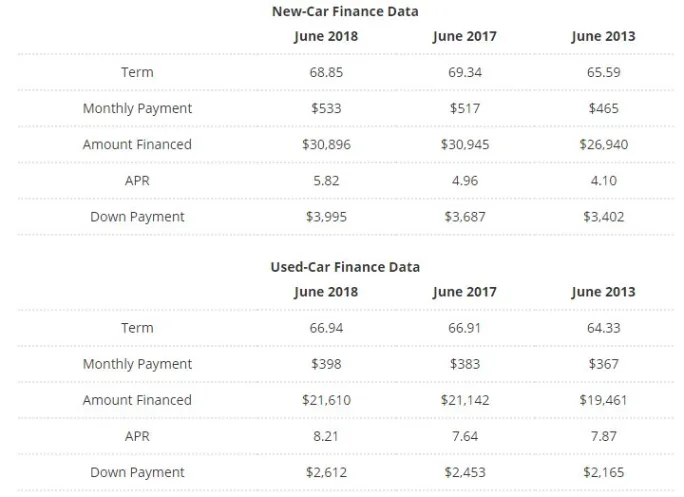
The annual percentage rate on new financed vehicle averaged 5.82% in June, up from 4.96% in June 2017 and 4.10 in June 2013. The firm’s analysts point to the most recent rate hike by the Federal Reserve as a contributing factor, noting that June marks a 17% total increase since January 2018, when APRs averaged just below 5%.
“Auto loan interest rates have been steadily on the rise this year and we don't see them going down anytime soon, which could mean trouble for automaker sales through the end of the year,” said Jeremy Acevedo, Edmunds' manager of industry analysis. "While some shoppers may take this as a cue to purchase new vehicles now while rates are still somewhat favorable, we're getting dangerously close to a tipping point. Shoppers with average or subprime credit may end up putting off purchases as financing vehicles get increasingly more expensive."
The firm noted that zero percent interest loans reached their lowest level in nine years in June, accounting for just 5.6% of total finance deals, compared to 9.47% in June 2017 and 10.55% in June 2013.
Edmunds revealed another problem in its midyear automotive trend report, which was released last week. It noted that the number of buyers who owe more than their vehicle is worth remains high, with 14.1% of buyers owing more than their car was worth. That’s down from 14.2% in 2017 and 14.6% in 2015 — the latter being a 14-year high.
"June typically boasts a substantial amount of zero percent financing offers, so this is a big red flag," added Acevedo. "This might be a sign that access to cheap and easy credit — a post-recession hallmark that we've all grown so accustomed to — could be officially over. But there's hope yet — the true indicator will be whether zero percent deals materialize through the rest of the summer selling season, which automakers typically rely on to clear outgoing model-year inventory."
Edmunds put June sales at 1.52 million new cars and trucks and the month’s seasonally adjusted annual rate at 17.1 million, reflecting a 4.1% decline in sales from May but a 3.4% increase from June 2017. Through May, 2018 sales were up 1.1% compared to the same period in 2017. However, the firm noted that the month-to-month fluctuations are enough to give the industry pause.
As for retail sales, Edmunds put June’s retail SAAR at 13.9 million units, with fleet transactions accounting for 18.4% of total sales. Additionally, 3.2 million used vehicles were expected to be sold in June, for a SAAR of 39.2 million. That down from 3.3 million used sales in May, which had a SAAR of 39.3 million.
The firm also noted that millennial new-vehicle purchases hit a record high through May, with 21% of millennial car purchase being new.
"The strength of the economy is creating a very thick force field for automakers now, but once that starts to weaken, there are a lot of market factors bubbling just below the surface that could really start to slow down sales," said Jeremy Acevedo, manager of industry analysis at Edmunds. "Even though millennials are finally starting to buy new vehicles, the U.S. market is virtually saturated. Add to that record-high vehicle prices, rising interest rates and historically high numbers of people who owe more than their cars are worth, and the stage is set for a market contraction."
Originally posted on F&I and Showroom
More Dealer Ops

How to Avoid Phone Scams | Dealer Debrief 09/10/2026
Are you taking the necessary steps to protect your dealership and customer data from phone-based scams? This week's Dealer Debrief breaks down how!
Read More →
Dealer Debrief: August Auto Sales
Gas-powered engines still dominate the U.S. vehicle market, but hybrids are gaining ground as consumers look for ways to cut their gas costs.
Read More →
Dealership Profits Decline
While new and used retail sales stagnated, dealerships have been particularly supported by fixed operations and finance-and-insurance profits, according to a new report.
Read More →
Dealer Debrief: Defection Data & EV Updates
In this week's debrief, host Lauren Lawrence discusses how to use defection data to your advantage and the latest on EV sales and charging infrastructure.
Read More →
How Defection Data is Bridging the Dealership Conversion Gap
Lead volume is flat, cross-shopping is up and brand loyalty is in retreat. As confident sales teams keep losing buyers they thought they had, daily industry sales data is showing dealers exactly where their funnel is breaking and how to fix it without buying a single new lead.
Read More →
Dealer Debrief: Where are you losing customers?
In this week's debrief, host Lauren Lawrence discusses the hidden leaks in dealerships where you might be losing customers without even realizing it.
Read More →
Dealer Debrief: Improving Your Inventory Management
In this week's debrief, host Lauren Lawrence covers a new survey that shows what service technicians really want and two launches that could help improve your inventory and vehicle life cycle management.
Read More →
Ladies and Gentlemen, This Is a Dealership: Why the Fundamentals Still Decide Who Wins
A teaching moment by a legendary football coach happens to apply perfectly in the auto retail space. Learn what it is and how to use it to your store’s advantage.
Read More →
Dealer Ads and the FTC
The agency has made it clear in recent enforcement actions and warnings, in auto retail and other industries, that advertised prices must include all nonoptional costs to the consumer.
Read More →
Used Autos Supply Dwindles
The March shopping surge, despite high prices, cut into inventory by the most since the thick of the pandemic, Cox Automotive analysts calculated.
Read More →