



More Drivers Using Green to Go 'Green,' Experian Finds
Latest Experian study shows consumers buying an alternative-powered vehicle are more likely to pay cash than those buying a gas-powered vehicle
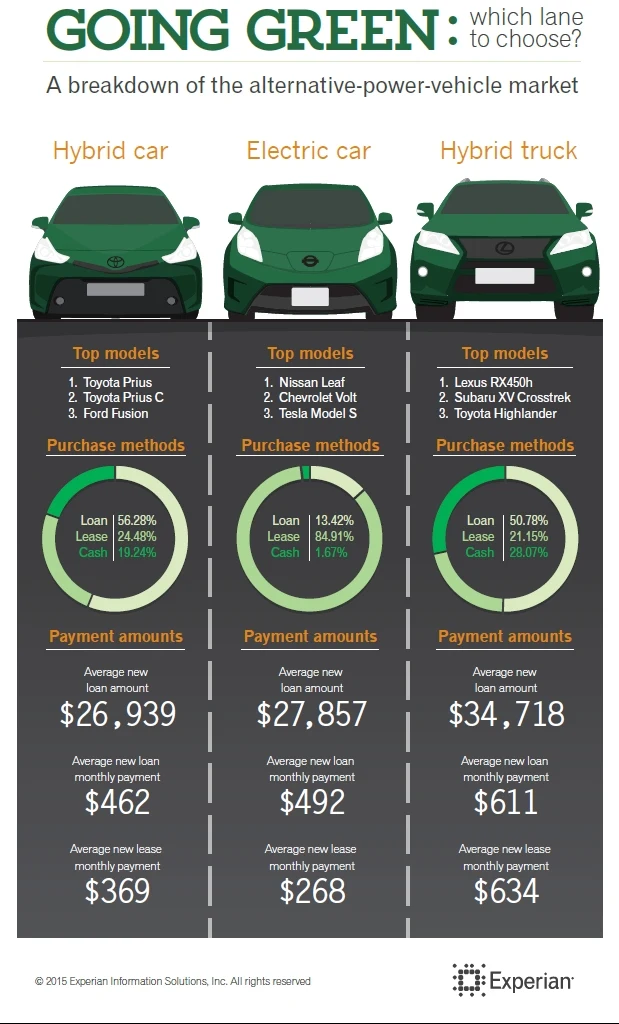
SCHAUMBURG, Ill. — In honor of Earth Day, Experian Automotive conduct an analysis of trends in the alternative-power vehicle marker. It found that consumers purchasing "green" vehicles tended to buy them with cash.
According to the analysis, more than 18% of consumers that purchased a “Green” vehicle paid in cash in 2014, compared to 15.24% of those who purchased a gas-powered vehicle.
“Despite the increases we have seen in automotive financing over the past few years, it’s interesting that a larger percentage of consumers buying green vehicles are choosing to buy with cash,” said Melinda Zabritski, senior director of automotive finance for Experian. “To put it in context, nationally, consumers purchased new vehicles with cash roughly only 16% of the time. A possible reason for this could be that consumers buying green vehicles are in the highest credit tiers, which could indicate they have more disposable income than those buying a gas vehicle.”
By being in the highest credit tiers, consumers purchasing green vehicles also tend to be a slightly lower credit risk than those purchasing traditional models. Nearly 83% of consumers who purchased an alternative-powered vehicle fell within the prime credit category, compared to 71.5% of consumers who purchased a gas-powered vehicle. Additionally, the average credit score of a consumer purchasing green was 737, while it was 711 for traditional vehicles.
From an overall market perspective, however, the percentage of new registered alternative-powered vehicles experienced a slight decrease year over year, falling from 4.1% in 2013 to 3.9% in 2014.
“While consumers purchasing an alternative-powered vehicle can satisfy their environmentally conscious side, the influx of traditionally powered vehicles with extremely high fuel efficiency have presented more options for consumers looking to save a buck at the fuel pump,” continued Zabritski.
At the model level, nearly 50% of all green vehicles registered in 2014 were Toyotas, led by the Toyota Prius (24.7%). The remaining top 10 included the Toyota Prius C (7.4%), Ford Fusion (6.9%), Toyota Camry (6.8%), Nissan Leaf (5.8%), Toyota Prius V (5.7%), Ford C-Max (4.2%), Hyundai Sonata (3.8%), Chevrolet Volt (3.5%) and Lexus CT 200h (3.3%).
For traditionally powered vehicles, the top model was the Honda Accord (3%), followed by the Ford F150 (2.8%), Honda CR-V (2.7%), Toyota Camry (2.6%), Chevrolet Silverado 1500 (2.6%), Honda Civic (2.6%), Toyota Corolla (2.2%), Toyota RAV4 (2%), Nissan Altima (2%) and the Ford Escape (2.0%).
Other findings:
In 2014, 53.3% of consumers financed the purchase of a “green” vehicle, while 70.2% of consumers took out a loan to purchase a traditional model.
For leases, 28.2% of consumers leased an alternative-powered vehicle in 2014, compared to 29.6% of consumers leasing a gas-powered vehicle.
The average finance amount for an alternative-powered vehicle in 2014 was $27,288, compared to $27,817 for a gas-powered vehicle
In 2014, the average monthly payment for an alternative-powered vehicle was $468; gas-powered vehicles were $473
The average lease payment for an alternative-powered vehicle was $358, compared to $407 for a gas-powered vehicle.
The top five states with the highest percentage of alternative-powered vehicle registrations in 2014 were California, Hawaii, Oregon, Washington and Georgia
More Dealer Ops

How to Avoid Phone Scams | Dealer Debrief 09/10/2026
Are you taking the necessary steps to protect your dealership and customer data from phone-based scams? This week's Dealer Debrief breaks down how!
Read More →
Dealer Debrief: August Auto Sales
Gas-powered engines still dominate the U.S. vehicle market, but hybrids are gaining ground as consumers look for ways to cut their gas costs.
Read More →
Dealership Profits Decline
While new and used retail sales stagnated, dealerships have been particularly supported by fixed operations and finance-and-insurance profits, according to a new report.
Read More →
Dealer Debrief: Defection Data & EV Updates
In this week's debrief, host Lauren Lawrence discusses how to use defection data to your advantage and the latest on EV sales and charging infrastructure.
Read More →
How Defection Data is Bridging the Dealership Conversion Gap
Lead volume is flat, cross-shopping is up and brand loyalty is in retreat. As confident sales teams keep losing buyers they thought they had, daily industry sales data is showing dealers exactly where their funnel is breaking and how to fix it without buying a single new lead.
Read More →
Dealer Debrief: Where are you losing customers?
In this week's debrief, host Lauren Lawrence discusses the hidden leaks in dealerships where you might be losing customers without even realizing it.
Read More →
Dealer Debrief: Improving Your Inventory Management
In this week's debrief, host Lauren Lawrence covers a new survey that shows what service technicians really want and two launches that could help improve your inventory and vehicle life cycle management.
Read More →
Ladies and Gentlemen, This Is a Dealership: Why the Fundamentals Still Decide Who Wins
A teaching moment by a legendary football coach happens to apply perfectly in the auto retail space. Learn what it is and how to use it to your store’s advantage.
Read More →
Dealer Ads and the FTC
The agency has made it clear in recent enforcement actions and warnings, in auto retail and other industries, that advertised prices must include all nonoptional costs to the consumer.
Read More →
Used Autos Supply Dwindles
The March shopping surge, despite high prices, cut into inventory by the most since the thick of the pandemic, Cox Automotive analysts calculated.
Read More →