



Subprime Auto Originations Fall to 10-Year Low
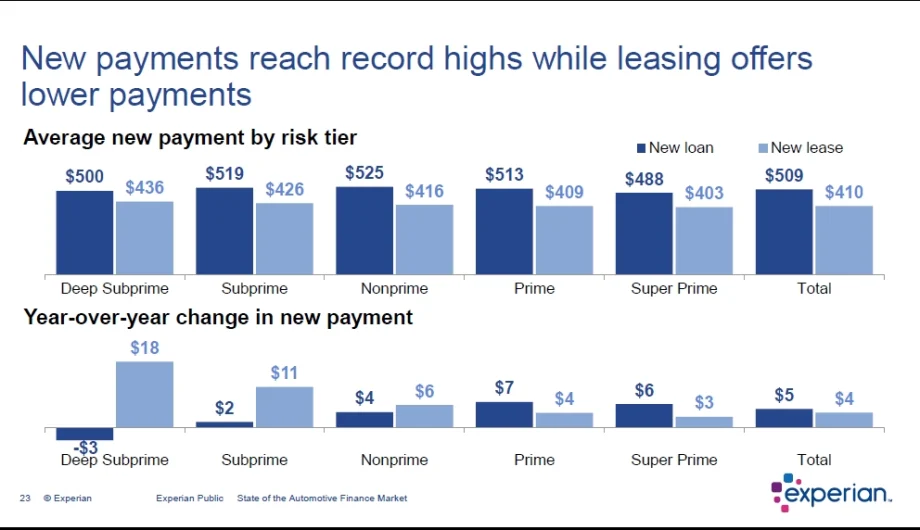
Reflecting the shift toward more creditworthy borrowers was the rise in average credit scores for both new- and used-vehicle loans. But the retreat from the high-risk tiers also comes during a quarter in which the average new-vehicle finance amount and monthly payment reached record highs.
SCHAUMBURG, Ill. — First-quarter vehicle registration data reveals that auto finance sources are moving toward more creditworthy car buyers, according to Experian Automotive. The shift pushed subprime auto originations to a 10-year low.
And with the total share of subprime and deep-subprime loans to drop from 26.48% in the year-ago quarter to 24.1%, the 30-day delinquency rate fell to 1.96% from 2.1% in first quarter of 2016, according to Experian Automotive. However, the 60-day delinquency rate rose slightly from 0.61% in the year-ago quarter to 0.67%.
“The truth is, lenders are making rational decisions based on shifts in the market,” the firm noted in its report. “When delinquencies started to go up, the lending industry shifted to more creditworthy customers.”
With the shift, average credit scores for both new and used-vehicle loans rose from 712 in the year-ago period to 717 and from 645 to 652, respectively. In fact, superprime was the only risk tier to grow for new-vehicle financing from a year ago, rising from 27.4% to 29.12%.
All other risk tiers lost share in the new-vehicle market lost share, with the percentage of prime originations falling slightly from 43.36% in the year-ago quarter to 43.04%. The share of nonprime originations fell from 17.83% to 16.96%, while subprime fell from 10.64% to 10.1%.
“For used vehicle loans, there was a similar upward shift in creditworthiness,” Experian Automotive noted. “Prime and superprime risk tiers combined for 47.4% market share in Q1 2017, up from 43.99% in Q1 2016.At the low end of the credit spectrum, subprime and deep-subprime share fell from 34.31% in Q1 2016 to 31.27% in Q1 2017.”
The upward shift in used vehicle loan creditworthiness is likely caused by an ample supply of late-model used vehicles. The firm also noted that leasing continues to rise and now accounts for 31.06% of all new-vehicle financing.
“Many of these leased vehicles have come back to the market as low-mileage used vehicles, perfect for CPO programs,” the firm noted, adding, “Another key indicator of the lease-to-CPO impact is the rise in used vehicle loan share for captives.”
In the first quarter, captives held an 8.3% share of used-vehicle financing, compared to 7.2% in the first quarter of 2016. Captives also continued to dominate the new-vehicle financing segment, increasing their share from 49.4% in the year-ago period to 53.9%.
The firm also noted that the average new-vehicle loan reached a record $30,534. The average monthly payment for a new-vehicle loan also reached a record $509.
Originally posted on F&I and Showroom
More Dealer Ops

How to Avoid Phone Scams | Dealer Debrief 09/10/2026
Are you taking the necessary steps to protect your dealership and customer data from phone-based scams? This week's Dealer Debrief breaks down how!
Read More →
Dealer Debrief: August Auto Sales
Gas-powered engines still dominate the U.S. vehicle market, but hybrids are gaining ground as consumers look for ways to cut their gas costs.
Read More →
Dealership Profits Decline
While new and used retail sales stagnated, dealerships have been particularly supported by fixed operations and finance-and-insurance profits, according to a new report.
Read More →
Dealer Debrief: Defection Data & EV Updates
In this week's debrief, host Lauren Lawrence discusses how to use defection data to your advantage and the latest on EV sales and charging infrastructure.
Read More →
How Defection Data is Bridging the Dealership Conversion Gap
Lead volume is flat, cross-shopping is up and brand loyalty is in retreat. As confident sales teams keep losing buyers they thought they had, daily industry sales data is showing dealers exactly where their funnel is breaking and how to fix it without buying a single new lead.
Read More →
Dealer Debrief: Where are you losing customers?
In this week's debrief, host Lauren Lawrence discusses the hidden leaks in dealerships where you might be losing customers without even realizing it.
Read More →
Dealer Debrief: Improving Your Inventory Management
In this week's debrief, host Lauren Lawrence covers a new survey that shows what service technicians really want and two launches that could help improve your inventory and vehicle life cycle management.
Read More →
Ladies and Gentlemen, This Is a Dealership: Why the Fundamentals Still Decide Who Wins
A teaching moment by a legendary football coach happens to apply perfectly in the auto retail space. Learn what it is and how to use it to your store’s advantage.
Read More →
Dealer Ads and the FTC
The agency has made it clear in recent enforcement actions and warnings, in auto retail and other industries, that advertised prices must include all nonoptional costs to the consumer.
Read More →
Used Autos Supply Dwindles
The March shopping surge, despite high prices, cut into inventory by the most since the thick of the pandemic, Cox Automotive analysts calculated.
Read More →