



Tesla vs. Firetruck: Feds to Investigate Latest Incident
Tesla’s ‘Autopilot’ setting has once again drawn interest from regulators after a Model S plowed into a parked firetruck.
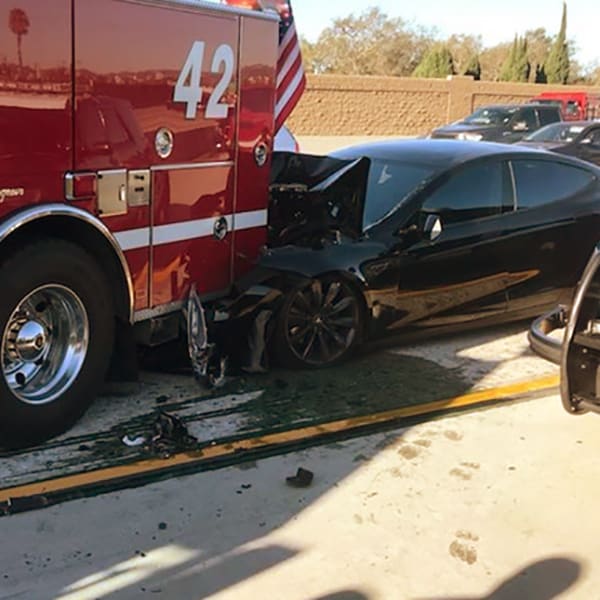
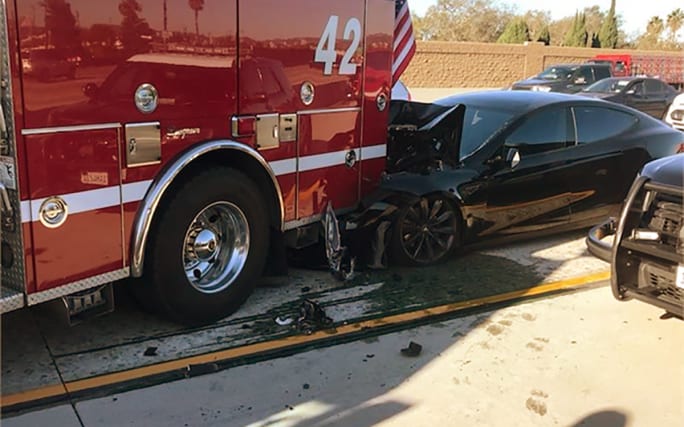
The driver of a Tesla Model S said the car was in “Autopilot” mode when it crashed into a fire truck in Culver City, Calif., on Jan. 22. Photo courtesy Culver City Fire Department via Twitter
CULVER CITY, Calif. — Two federal safety agencies have opened investigations into why a Tesla Model S — which the driver said was operating in “Autopilot” mode — plowed into a firetruck parked on the side of a Los Angeles-area freeway, according to Reuters and Bloomberg reports.
The National Highway Traffic Safety Administration (NHTSA) and the National Transportation Safety Board (NTSB) will conduct separate probes of the Jan. 22 crash, focusing primarily on the performance of the car’s advanced driver-assistance systems and the driver’s actions. The collision occurred while Culver City firefighters were assisting with the cleanup of an earlier crash on the 405 freeway.
Though the Tesla Model S was traveling 65 miles per hour, nobody was injured in the crash, according to a tweet that the Culver City Firefighters union sent out shortly after the accident.
A Tesla Model S in Autopilot — or semi-autonomous — mode uses advanced driver assistance systems, but still falls well short of industry criteria for what’s considered a fully automated vehicle. The driver, according to Tesla, still needs to be fully attentive.
This isn’t the first time a crash involving a Tesla in Autopilot mode has drawn federal scrutiny.
Last September, NTSB ruled that the probable cause of a 2016 fatal crash involving a Tesla Model S 70D was a truck driver’s failure to yield the right of way and the Tesla driver’s “inattention due to over-reliance on vehicle automation.” Months earlier, NHTSA had also concluded that the Tesla sedan had no safety defects that contributed to the deadly collision in Florida.
If NHTSA’s probe into the California crash uncovers a vehicle safety defect, the agency can direct Tesla to issue a safety recall to resolve the problem.
Originally posted on F&I and Showroom
More Dealer Ops
How to Avoid Phone Scams | Dealer Debrief 09/10/2026
Are you taking the necessary steps to protect your dealership and customer data from phone-based scams? This week's Dealer Debrief breaks down how!
Read More →
Dealer Debrief: August Auto Sales
Gas-powered engines still dominate the U.S. vehicle market, but hybrids are gaining ground as consumers look for ways to cut their gas costs.
Read More →
Dealership Profits Decline
While new and used retail sales stagnated, dealerships have been particularly supported by fixed operations and finance-and-insurance profits, according to a new report.
Read More →
Dealer Debrief: Defection Data & EV Updates
In this week's debrief, host Lauren Lawrence discusses how to use defection data to your advantage and the latest on EV sales and charging infrastructure.
Read More →
How Defection Data is Bridging the Dealership Conversion Gap
Lead volume is flat, cross-shopping is up and brand loyalty is in retreat. As confident sales teams keep losing buyers they thought they had, daily industry sales data is showing dealers exactly where their funnel is breaking and how to fix it without buying a single new lead.
Read More →
Dealer Debrief: Where are you losing customers?
In this week's debrief, host Lauren Lawrence discusses the hidden leaks in dealerships where you might be losing customers without even realizing it.
Read More →
Dealer Debrief: Improving Your Inventory Management
In this week's debrief, host Lauren Lawrence covers a new survey that shows what service technicians really want and two launches that could help improve your inventory and vehicle life cycle management.
Read More →
Ladies and Gentlemen, This Is a Dealership: Why the Fundamentals Still Decide Who Wins
A teaching moment by a legendary football coach happens to apply perfectly in the auto retail space. Learn what it is and how to use it to your store’s advantage.
Read More →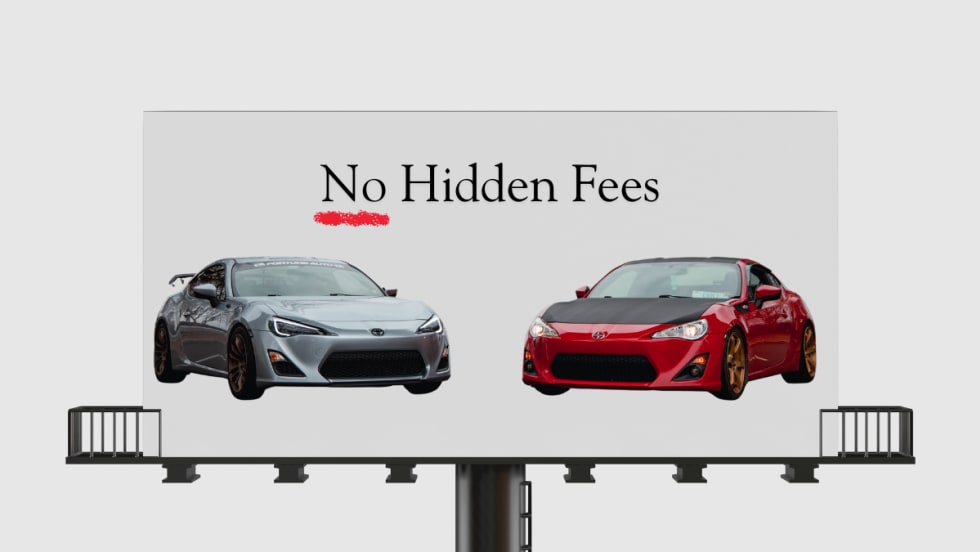
Dealer Ads and the FTC
The agency has made it clear in recent enforcement actions and warnings, in auto retail and other industries, that advertised prices must include all nonoptional costs to the consumer.
Read More →
Used Autos Supply Dwindles
The March shopping surge, despite high prices, cut into inventory by the most since the thick of the pandemic, Cox Automotive analysts calculated.
Read More →