



TransUnion: Auto Originations Fall for Third Consecutive Quarter
First-quarter auto loan originations declined 2.9% from the year-ago period to 6.73 million in the first quarter, the third consecutive quarter of year-over-year declines and the first decline in origination growth in any first quarter since 2010. Officials attribute the drop to the subprime retreat.

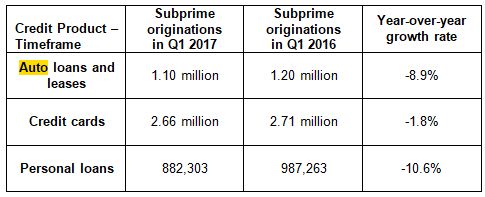
CHICAGO — Subprime originations registered their first decline since 2012, according to TransUnion’s quarterly Industry Insights Report. It found that 4.63 million subprime consumers originated an auto loan or lease, personal loan, or credit card in the first quarter, down from 4.89 million in the first quarter of 2016.
The firm attributed the decline to a combination of factors, including funding issues among fintech finance sources and tightening underwriting standards due to the recent uptick in delinquencies. The latter is especially true in the auto finance industry, where the delinquency rate increased 10.8% from a year ago to 1.23% in the second quarter.
“Immediately following the recession, many lenders pulled back on subprime originations to control delinquency. As the economy recovered, lenders loosened their underwriting standards and allowed more subprime consumers greater access to credit,” said Ezra Becker, senior vice president of research and consulting for TransUnion. “It appears that this trend may now be changing, though it is a much different environment than what we observed just after the recession. The economy is performing well, and after several years of increased subprime lending, some lenders may simply be taking a pause.”
In the first quarter, subprime personal loan originations declined 10.6% year over year, compared to a positive annual growth rate of 11% in first quarter of 2016. This marked three straight quarters of year-over-year declines in originations, as more than 100,000 fewer subprime consumers opened a personal loan in 2017’s opening quarter vs. the year-ago period.
In the credit card segment, subprime originations declined by 1.8% to start 2017, the second consecutive quarter of decline. Since 2014, subprime originations had increased at a rapid rate, averaging a growth of 29.2% in the first quarters of 2014, 2015, and 2016. In this year’s opening quarter, subprime originations declined at nearly the same rate as total originations (down 1.9%).
As for the auto finance arena, the firm noted that the slight rise in delinquencies was expected after several years of finance sources offering more financing opportunities to nonprime consumers. Officials noted, however, that delinquencies remain at low levels.
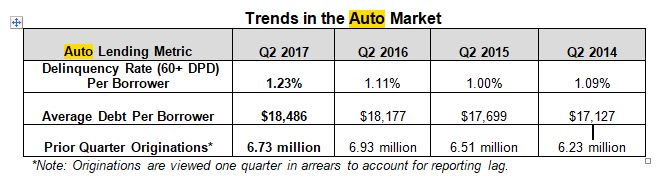
Auto originations in the first quarter declined 2.9% from the year-ago period to 6.73 million, marking the third consecutive quarter of year-over-year declines in auto loan originations and the first decline in origination growth in any first quarter since 2010.
“Lenders have also raised concerns about the downward pressure on used-car values, and we are beginning to see this impact origination growth,” added Brian Landau, senior vice president and automotive business leader for TransUnion.
Despite this decline total auto balances reached a new high of $1.145 trillion in the first quarter — a 6.9% increase from the year-ago period.
“A combination of factors has influenced the decline in subprime personal loan originations. For example, fintech lenders faced funding challenges in Q2 2016,” said Becker. “After years of growth in auto lending for subprime consumers, not surprisingly we observed an uptick in auto delinquency. Higher delinquency rates have long been anticipated as the result of that credit expansion. The reduction in subprime auto lending is a natural reaction to the emergence of that increased delinquency.”
Originally posted on F&I and Showroom
More Dealer Ops

Dealership Profits Decline
While new and used retail sales stagnated, dealerships have been particularly supported by fixed operations and finance-and-insurance profits, according to a new report.
Read More →
Dealer Debrief: Defection Data & EV Updates
In this week's debrief, host Lauren Lawrence discusses how to use defection data to your advantage and the latest on EV sales and charging infrastructure.
Read More →
How Defection Data is Bridging the Dealership Conversion Gap
Lead volume is flat, cross-shopping is up and brand loyalty is in retreat. As confident sales teams keep losing buyers they thought they had, daily industry sales data is showing dealers exactly where their funnel is breaking and how to fix it without buying a single new lead.
Read More →

Dealer Debrief: Where are you losing customers?
In this week's debrief, host Lauren Lawrence discusses the hidden leaks in dealerships where you might be losing customers without even realizing it.
Read More →
Dealer Debrief: Improving Your Inventory Management
In this week's debrief, host Lauren Lawrence covers a new survey that shows what service technicians really want and two launches that could help improve your inventory and vehicle life cycle management.
Read More →
Ladies and Gentlemen, This Is a Dealership: Why the Fundamentals Still Decide Who Wins
A teaching moment by a legendary football coach happens to apply perfectly in the auto retail space. Learn what it is and how to use it to your store’s advantage.
Read More →
Dealer Ads and the FTC
The agency has made it clear in recent enforcement actions and warnings, in auto retail and other industries, that advertised prices must include all nonoptional costs to the consumer.
Read More →
Used Autos Supply Dwindles
The March shopping surge, despite high prices, cut into inventory by the most since the thick of the pandemic, Cox Automotive analysts calculated.
Read More →
Managing Risk Effectively Through Changing Times
The variables influencing risk pricing have changed significantly over the past five years. Being proactive and responsive to emerging trends is not optional but essential.
Read More →
Survey Reveals What Won't Fix What's Breaking Car Sales
AutoPayPlus says extra-long auto loans are trapping consumers and threatening the dealer trade-in cycle, and that the industry is leveraging the wrong tools to combat high MSRPs.
Read More →