



Dealers Step Up When Disaster Strikes
From wildfires to hurricanes, auto dealers take action to provide financial support and emergency services to first responders, employees, and their communities.
May 1, 2025


Auto dealerships play a key role in disaster response by supplying emergency vehicles, repairs, and rapid recovery resources.
Photo Credit: Getty Images/Wirestock
7 min to read
The wildfires that swept Southern California in January were preceded by dire warnings from the National Weather Service’s Storm Prediction Center (SPC). On Jan. 3, 2025, the SPC alerted the region that persistent drought and high winds had created an “extremely critical risk” for wildfires. The first blaze broke out four days later.
Over the next three weeks, 14 fires would burn through more than 57,000 acres across six counties, killing at least 30 people and destroying more than 18,000 structures. With preliminary damage estimates exceeding $250 billion, the wildfires may be the costliest natural disaster in U.S. history.
The most severe fires were both in Los Angeles County: The Eaton Fire started in the San Gabriel Mountains due north of downtown L.A. and would destroy much of the foothill community of Altadena, causing at least 18 deaths; 25 miles to the west, the Palisades Fire tore through the coastal communities of Pacific Palisades, Topanga, and Malibu, killing 12.
As it often does in the face of death and destruction, the auto dealer community stepped up to help industry members and others in need.
Financial and Humanitarian Aid
In the early 2000s, the National Association of Automobile Dealers’ (NADA) Foundation established its emergency relief fund, which offers individual grants of up to $1,500 for dealership employees who have suffered financial losses that can’t be recouped through insurance or other grants. The foundation raised over $4 million after Hurricanes Katrina and Rita slammed the Gulf Coast in 2005.
As the Southern California wildfires raged, the NADA Foundation’s directors went into fundraising mode. The final tally was yet to be announced as of publication, but some parties have reported donations. Among them is the California New Car Dealers Association, which raised and contributed $100,000.
“We were deeply concerned to hear about the wildfires in Southern California,” CNCDA President Brian Maas wrote in a February press release. “We’ve been in close communication with our dealer members and have extended our support for their employees who were most affected by this crisis, ensuring they are safe and cared for. CNCDA’s members remain committed to providing assistance to their fellow dealers in the aftermath of this tragedy.”
Help rolled in from across the country and around the world. The American Red Cross received $1 million each from BMW Group, while Honda Motor Co. and Mercedes-Benz USA kicked in $500,000. Hyundai Motor America and Genesis Motor America donated $100,000 to the Red Cross and the Los Angeles Fire Department Foundation.
In Colorado Springs, Colorado, Kevin Shaughnessy followed the news with equal parts concern and sympathy. Years earlier, the president & CEO of Phil Long Dealerships had watched wildfires ravage his community. He decided to take action.
Support for First Responders
The Phil Long group includes 14 franchises in 18 locations and 25 rooftops, including three Ford stores. Ford Motor Co. would marshal more than $465,000 in contributions to multiple organizations, including $30,000 collected from Colorado Ford dealers and donated to the Los Angeles Fire Department.
Shaughnessy and the Phil Long leadership team matched that amount with a $30,000 donation to Team Rubicon. The global, veteran-led organization aided Southern Californians displaced by the fires, providing emergency medical care, clearing debris and safety hazards, and assessing and mapping damage.
The dealer group’s contribution followed a tradition of philanthropy established by founder Phil Long, a decorated World War II fighter pilot, and longtime business partner Jay Cimino, a U.S. Marine Corps veteran. Cimino, who died in 2024 after more than 40 years with the group, founded three nonprofits in his hometown of Trinidad, Colorado, and his adopted home of Colorado Springs, where he established the Mt. Carmel Veterans Service Center.
“Don’t ask if someone needs help. Just help. That’s what Jay modeled for me,” Shaughnessy said. When Cimino proposed the veterans center, people told him “the situation was unfixable. And Jay, rather than shy away, took it as a challenge.”
Major challenges arrived in 2012 and 2013 in the form of Colorado’s second- and third-most destructive wildfires. The Waldo Canyon Fire started June 23, 2012, in the San Isabel National Forest, northwest of Colorado Springs. As firefighters, the U.S. Forest Service, the Red Cross, and other first responders rolled into town, Cimino pledged to dedicate every available resource to support them.
“We kept our parts and service departments open 24 hours,” Shaughnessy said. “We told them to bring it in if something goes wrong with the firetruck, even if it’s 2 a.m. We saw a lot of melted tires. And as a result, our dealerships became rest stations for firefighters. We’d get them and their trucks back in the fight as quickly as we could.”
As for the Red Cross, “they needed water and trucks. So we loaded our trucks with pallets of water and gave them the keys,” he added.
Waldo would burn more than 18,000 acres, cause the deaths of two Colorado Springs residents, and destroy 346 homes by the time it was fully contained on July 10. It was the most destructive wildfire in state history for just under one year. In June 2013, the Black Forest Fire killed two while burning more than 14,000 acres and 511 homes, also in the Colorado Springs area.
This time, Shaughnessy and his team knew what to expect and how to respond. A year earlier, he noted that “it was all done on the fly. We were driving on the road while we were still paving it. But there was no time to construct a plan. The speed at which it all happened was shocking.”

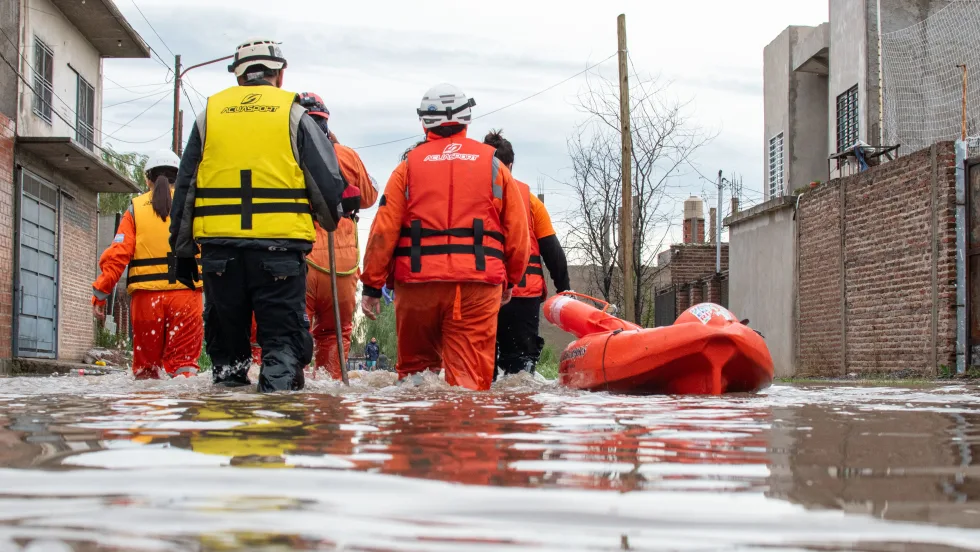
Flood waters can ravage areas during and after a storm, making it difficult to get supplies to communities in need.
Photo Credit: Getty Images/lutherhill
A 500-Year Flood
Hurricane Helene slammed into Florida’s Big Bend coast on Sept. 26, 2024, having spent two days traveling north through the Gulf of Mexico and gaining intensity after forming as a tropical storm in the western Caribbean Sea. Driven by 140-mile-per- hour winds, the Category 4 hurricane would leave a trail of devastating rainfall, storm surge, floods, and tornadoes before petering out over Tennessee three days later.
Helene caused the deaths of at least 250 people, including 107 in Western North Carolina. That’s where Randy Hunter owns and operates Hunter Auto Group, which includes Hyundai, Subaru, and Volvo franchises. He also serves as the chairman of the North Carolina Automobile Dealers Association (NCADA).
Hunter’s new car dealerships are on a 20-acre campus near the Western North Carolina Agricultural Center in Fletcher, North Carolina.
“They have a gravel parking lot that slopes uphill,” Hunter said. “We needed to move cars to higher ground. I put a call in to the agricultural commissioner, Steve Troxler. He called me back and said ‘Move those cars, no problem.’”
On the evening of Sept. 26, the Hunter team relocated about 500 new, used, and wholesale units. Still, as the weather intensified, they were forced to leave behind several customer cars and at least 70 dealer-owned units. The next morning, a member of the fixed ops team checked on the dealerships.
“He said things looked good,” Hunter recalled. “But this was a 500-year flood. By Saturday night, we weren’t good.”
The dealerships were filled with four feet of muddy water, destroying all the vehicles, furniture, computers, and equipment. By the end of Sunday, the water had receded, and Hunter asked everyone available to report for work on Monday morning. By Thursday, one showroom and all three service departments were open.
But getting back to business wasn’t Hunter’s first priority.
“Initially, we looked inwardly,” he said. “We cooked meals for employees. We sent an email blast through HR saying we are up and running, giving everyone five days of PTO and each service tech a $500 tool allowance. Anyone who lost their home or was displaced was supported through our foundation, the Hunter Hometown Association. And HR set up a table to help them apply for grants through the NADA and NCADA disaster funds.”
Meanwhile, Hunter’s fellow dealers sent food, water, and other supplies via the neighboring Asheville Regional Airport by plane and helicopter. It was far more than the group’s employees needed.
“Then we reached out to the community,” Hunter said. “We said if anybody needs anything, come by and see us.”

Kevin Shaughnessy, president and CEO of Phil Long Dealerships, didn’t let wildfires take his community down.
Phil Long Dealerships
Have a Plan
Asked what advice he would share with other dealers who want to serve their employees, customers, and communities in crisis, “Be ready. Have a plan,” Hunter said. “Understand what kind of disaster might hit your area and know what button you need to hit if that happens. Before Helene, we didn’t have a concrete plan in place except ‘We gotta move these cars.’”
Shaughnessy urges dealers to recognize that they can make a difference for their employees, communities, and beyond.
“Every raindrop contributes to the flood,” he said. “When we saw the wildfires in L.A., it felt like there was nothing we could do to help. But you recognize the fire will run out of fuel and a giant mess will be left behind.”
“Another dealer I respected was Larry Miller,” Shaughnessy added. “He said, ‘Keep doing good until there’s too much good in the world.’”
About the Author: Tariq Kamal is an auto industry executive and consultant.
Subscribe to Our Newsletter
More Disaster Response
OEMs Deliver Disaster Relief
Following several bouts of severe weather across the U.S., automakers have made significant donations to disaster-relief efforts.
Read More →
From Coverage to Evacuation: How to Protect Your Business in a Disaster
Auto dealers, fleet managers and other vehicle-based business operators must protect themselves, their people and assets when natural disasters strike. An insurance expert explains how to create a response plan you can rely on.
Read More →