



Black Book: Market Update
Declines in wholesale prices continued last week, despite an improvement in conversion rates.

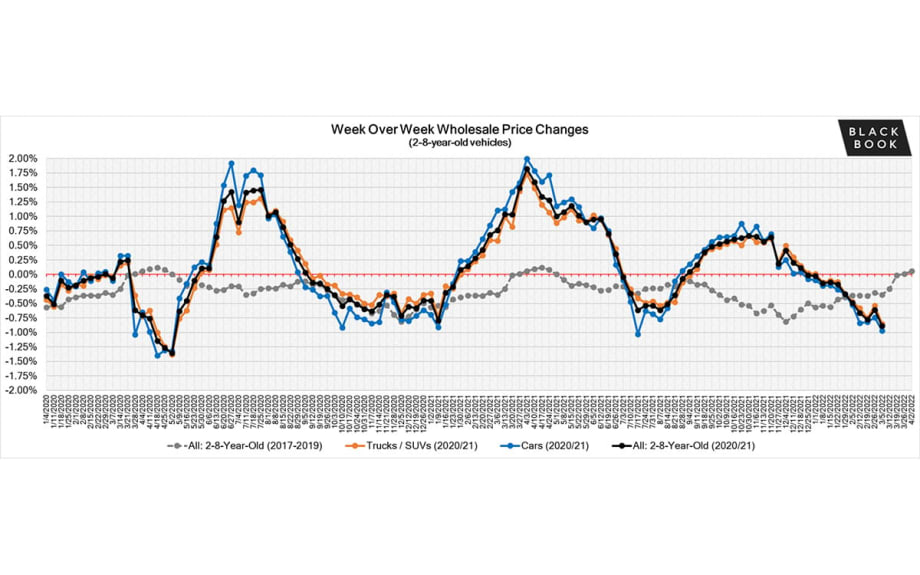
Declines in wholesale prices continued last week, despite an improvement in conversion rates.
BLACK BOOK – Wholesale Prices, Week Ending March 5th
Declines continued last week, despite an improvement in conversion rates. Full-Size Vans continue to be the anomaly, but the rate of increase is slowing down, with the segment only increasing by +0.11% last week, the lowest rate of gain since the week of July 23, 2021 (+0.09%).
This Week Last Week 2017-2019 Average (Same Week)
Car segments -0.97% -0.75% -0.32%
Truck & SUV segments -0.85% -0.54% -0.38%
Market -0.89% -0.61% -0.35%
Car Segments
On a volume-weighted basis, the overall Car segment decreased -0.97%. For reference, the previous week, cars decreased by -0.75%.
All nine Car segments declined last week.
For a third consecutive week, Mid-Size Cars reported the largest decline in values, with a depreciation of -1.45% last week, compared to the prior week of -1.19%.
Sporty Car (-1.11%) and Prestige Luxury Car (-1.12%) also had large declines, accelerating from the prior weeks’ large declines of -1.04% and -0.95%, respectively.
Truck / SUV Segments
The volume-weighted, overall Truck segment decreased -0.85%, compared to the prior week’s decrease of -0.54%.
Twelve out of the thirteen Truck segments reported declines.
Full-Size Vans (+0.11%) reported another increase last week, but the pace of gains is slowing (prior week increase was +0.50%).
With the exception of Full-Size Vans, all Truck segments reported declines exceeding -0.50%.
Minivans declined -1.52%, the largest decrease for the segment since early in the pandemic.
Weekly Wholesale Index
Calendar year 2020 and 2021 ended with used wholesale prices at elevated levels. With economic patterns (including the automotive market) driven by the pandemic, normal seasonal patterns (e.g., 2019 calendar year) in the wholesale market were not observed for most of the last 2 years. We saw a similar picture in 2009, at the end of the Great Recession. Calendar year 2021 did not have typical seasonality patterns as the market had rapid increases in wholesale values for the majority of the year. The Wholesale Weekly Price Index reached the highest point of the year at the end of December, reporting over 1.51 points. Now, in calendar year 2022, the index has been reverted back to the 1.00 mark and overall wholesale prices have remained relatively stable in the month of January (green line). As we move into March, the Wholesale Weekly Price Index continues to decline and is now just below the 2019 trend line around 0.97.
The graph below looks at trends in wholesale prices of 2-6-year-old vehicles, indexed to the first week of the year. The index is computed keeping the average age of the mix constant to identify market movements.
Retail (Used and New) Insights
Ford announced a reorg. splitting their ICE and EV businesses, with the EV unit being named Ford Model e, while gasoline vehicles will fall under Ford Blue; goals for this split include increased profit margins and specializing engineers, designers, and developers.
Volkswagen announced plans to build a Passat-sized self-driving, long-range electric sedan, that will be built at a new Wolfsburg EV plant.
Honda has partnered with Sony to form a new company to plan, design, develop, and sell EVs – sales are expected to start in 2025.
Hyundai Motor plans to invest $16B in electrification through 2030 and launch 17 new EV models across Hyundai and Genesis brands.
Polestar unveiled a new O2 concept 2+2 hard-top convertible roadster, dubbed the “hero car” for the Polestar brand.
Used Retail Prices
Used Retail Prices are more accessible than in years past, due to the proliferation of ‘no-haggle pricing’ for used-vehicle retailing. Transparent pricing upfront makes the car buying process more enjoyable for customers and allows Black Book to accurately measure retail market trends.
At the on-set of the pandemic, in CY2020, used retail prices increased slightly, following typical seasonal patterns, and then began dropping in April, finally hitting a low point in the late spring months. By late summer of CY2020, Used Retail Prices increased as supply of new vehicle inventory started to become scarce, but retail demand slowed down at the end of CY2020, resulting in declining retail asking prices for the last several weeks of the year. When CY2021 kicked off, demand rebounded while retail prices lagged slightly behind wholesale prices; March of 2021 started the dramatic increases in Used Retail Prices, fueled by stimulus payments, tax season, and shortages of new inventory. During the third quarter, retail prices continued to rise at a slower rate but soon picked up the pace once again to start the fourth quarter. In Q4, prices on retail listings steadily increased week after week. As CY2021 came to an end, the retail listing price index closed 36% above where the year began.In the two months of 2022, the Retail Listings Price Index remained relatively unchanged (green curve on the graph below), but as we head into March, the Index sits just above 0.99, indicating a very slight decrease in retail pricing. Typically, there is a lag between changes in wholesale prices and retail prices.This analysis is based on approximately two million vehicles listed for sale on U.S. dealer lots. The graph below looks at 2-6-year-old vehicles. The index is computed keeping the average age of the mix constant to identify market movements.
Inventory
Used Retail
Used Retail Listing Volume has creeped up some this week, as dealers prepare for the upcoming spring / tax-season market. News coverage broke this week about a possible second wave of chip shortages, due to neon scarcity; with plants shutting down again, used vehicles will continue to drive the market.
Used Retail Days-to-Turn has dropped slightly and now sits around 42 days, which is remarkably similar to pre-pandemic norms.
Wholesale
Wholesale values continue to drop — the volume-weighted overall decline of –0.89% is nearly three times the decline seen in the same week pre-pandemic. This change in week-over-week values paired with the rolling back of COVID restrictions means lanes are extremely active with more buyers in lane and vehicles running through at many auction locations. Independent dealers, rental companies, and franchise dealers alike are competing for cleaner inventory. Auto part shortages and supply chain issues are still causing delays in repairs, so the competition for desirable vehicles may be intense. With floor prices continuing to drop and many US workers going back to work, there is some hope for a typical spring market.
The Estimated Average Weekly Sales Rate has picked up and is at 64% this week. This is another good sign of a traditional spring / tax-season market. In March of 2021, the Estimated Average Weekly Sales Rate increased around 10 percentage points in a 6-week period, from around 64% to 75%.
Originally posted on F&I and Showroom
More Dealer Ops

Dealer Debrief: August Auto Sales
Gas-powered engines still dominate the U.S. vehicle market, but hybrids are gaining ground as consumers look for ways to cut their gas costs.
Read More →
Dealership Profits Decline
While new and used retail sales stagnated, dealerships have been particularly supported by fixed operations and finance-and-insurance profits, according to a new report.
Read More →
Dealer Debrief: Defection Data & EV Updates
In this week's debrief, host Lauren Lawrence discusses how to use defection data to your advantage and the latest on EV sales and charging infrastructure.
Read More →

How Defection Data is Bridging the Dealership Conversion Gap
Lead volume is flat, cross-shopping is up and brand loyalty is in retreat. As confident sales teams keep losing buyers they thought they had, daily industry sales data is showing dealers exactly where their funnel is breaking and how to fix it without buying a single new lead.
Read More →
Dealer Debrief: Where are you losing customers?
In this week's debrief, host Lauren Lawrence discusses the hidden leaks in dealerships where you might be losing customers without even realizing it.
Read More →
Dealer Debrief: Improving Your Inventory Management
In this week's debrief, host Lauren Lawrence covers a new survey that shows what service technicians really want and two launches that could help improve your inventory and vehicle life cycle management.
Read More →
Ladies and Gentlemen, This Is a Dealership: Why the Fundamentals Still Decide Who Wins
A teaching moment by a legendary football coach happens to apply perfectly in the auto retail space. Learn what it is and how to use it to your store’s advantage.
Read More →
Dealer Ads and the FTC
The agency has made it clear in recent enforcement actions and warnings, in auto retail and other industries, that advertised prices must include all nonoptional costs to the consumer.
Read More →
Used Autos Supply Dwindles
The March shopping surge, despite high prices, cut into inventory by the most since the thick of the pandemic, Cox Automotive analysts calculated.
Read More →
Managing Risk Effectively Through Changing Times
The variables influencing risk pricing have changed significantly over the past five years. Being proactive and responsive to emerging trends is not optional but essential.
Read More →