



NHTSA Issues Urgent Warning to 313,000 Honda, Acura Owners
New tests on Takata airbag inflators show that certain model-year 2001-2003 Honda and Acura vehicles have up to a 50% chance of rupturing during a crash, according to a National Highway Traffic Safety Administration (NHTSA) alert.
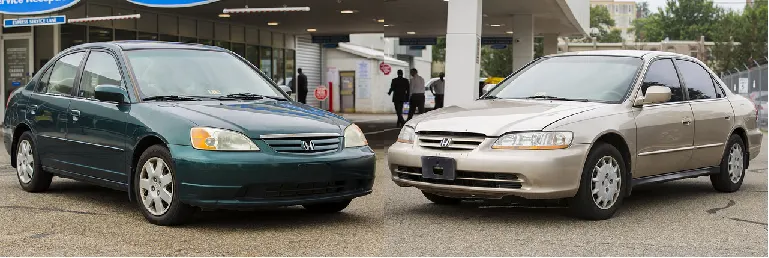
Two Honda models that contain the dangerous Takata air bag inflators.
WASHINGTON — New tests on Takata airbag inflators have found that certain model-year 2001-2003 Honda and Acura vehicles have up to a 50% chance of a dangerous rupture during a crash, according to a National Highway Traffic Safety Administration (NHTSA) alert.
“ … these vehicles are unsafe and need to be repaired immediately,” said U.S. Transportation Secretary Anthony Foxx. “Folks should not drive these vehicles unless they are going straight to a dealer to have them repaired immediately, free of charge.”
The models that are affected by the specific defective air bags are the 2001-2003 Honda Civic and Accord; the 2002 Honda CR-V and Odyssey; the 2002-2003 Acura TL; and the 2003 Acura CL and Honda Pilot.
The airbags in these vehicles, according to the NHTSA, contain a manufacturing defect that greatly increases the potential for dangerous rupture during a crash that causes the air bag to deploy. Testing on vehicles with the defective airbags in areas of high humidity — like Florida, Texas, other parts of the Gulf Coast, and Southern California — resulted in rupture rates that at times exceeded 50%.
Affected vehicles were originally recalled between 2008 and 2011. However, when recent reports of ruptures in the recalled vehicles were sent to the NHTSA, the regulator ordered Takata to perform additional ballistic testing on the inflators.
According to Honda, more than 70% of the higher-risk vehicles have already been repaired. Even with those repairs, there are still approximately 313,000 vehicles with the defect still on the roads, Honda stated.
“The air bag inflators in this particular group of vehicles pose a grave danger to drivers and passengers that must be fixed right away,” said NHTSA Administrator Dr. Mark Rosekind. "Drivers should visit SaferCar.gov or contact their local dealer to check whether their vehicle is affected. If it is, they should have the vehicle repaired immediately for free at an authorized dealer. We commend Honda for taking additional actions to get these vehicles repaired.”
Originally posted on F&I and Showroom
More Dealer Ops

How to Avoid Phone Scams | Dealer Debrief 09/10/2026
Are you taking the necessary steps to protect your dealership and customer data from phone-based scams? This week's Dealer Debrief breaks down how!
Read More →
Dealer Debrief: August Auto Sales
Gas-powered engines still dominate the U.S. vehicle market, but hybrids are gaining ground as consumers look for ways to cut their gas costs.
Read More →
Dealership Profits Decline
While new and used retail sales stagnated, dealerships have been particularly supported by fixed operations and finance-and-insurance profits, according to a new report.
Read More →
Dealer Debrief: Defection Data & EV Updates
In this week's debrief, host Lauren Lawrence discusses how to use defection data to your advantage and the latest on EV sales and charging infrastructure.
Read More →
How Defection Data is Bridging the Dealership Conversion Gap
Lead volume is flat, cross-shopping is up and brand loyalty is in retreat. As confident sales teams keep losing buyers they thought they had, daily industry sales data is showing dealers exactly where their funnel is breaking and how to fix it without buying a single new lead.
Read More →
Dealer Debrief: Where are you losing customers?
In this week's debrief, host Lauren Lawrence discusses the hidden leaks in dealerships where you might be losing customers without even realizing it.
Read More →
Dealer Debrief: Improving Your Inventory Management
In this week's debrief, host Lauren Lawrence covers a new survey that shows what service technicians really want and two launches that could help improve your inventory and vehicle life cycle management.
Read More →
Ladies and Gentlemen, This Is a Dealership: Why the Fundamentals Still Decide Who Wins
A teaching moment by a legendary football coach happens to apply perfectly in the auto retail space. Learn what it is and how to use it to your store’s advantage.
Read More →
Dealer Ads and the FTC
The agency has made it clear in recent enforcement actions and warnings, in auto retail and other industries, that advertised prices must include all nonoptional costs to the consumer.
Read More →
Used Autos Supply Dwindles
The March shopping surge, despite high prices, cut into inventory by the most since the thick of the pandemic, Cox Automotive analysts calculated.
Read More →